Showing posts with label Politics. Show all posts

Herewith the Clues (1939)


Who killed Serge Orloff, Trotskyite enabler of the Irish Republican Army, dope-peddler and West-End club owner?

Herewith the Clues is the fourth and last of the crime dossiers Wheatley created in collaboration with J.G. Links. The series was already in decline but this is by some measure the weakest and least interesting: its original readers seem to have concluded that the idea had definitely run its course, and it's hard not to agree with them. (I have the advantage over them, of course, in knowing that it actually had.)

It's by far the most linear and  least convoluted; it makes less of an effort than ever to make the tangibility of its assembled evidence relevant to the solution, and there are no surprises at all. There's only one killing, and we arrive at the solution by examining the testimony of a series of interchangeable suspects, a fact which the authors make clear at the end by providing (for the first time) readers' score sheets, which explicitly tell them to list the suspects and their reasons for exonerating or continuing to suspect them. (The latter, one suspects, are as much a means of filling up space in the book as in offering help to the sleuths at home.)
It begins as a series of letters describing the events - this could easily be third person prose and would lose nothing - we then get a look at the bits of evidence, then see photos and descriptions of all the suspects, and that's that: we jump straight to the solution. It's all very mechanical, and I read the lot in half an hour. The cover boasted that it contained "five times as many clues as any of the previous dossiers", which may be true in a strictly numerical sense, but the amount of informed guessing the reader is able to do is virtually nil.
Wheatley, who had some frosty words of criticism for its predecessor, The Malinsay Massacre, betrays no feelings of disenchantment or disappointment with the present venture in Drink and Ink, stressing that the run of the series was curtailed only by the cost of producing them, which became prohibitive in wartime. Phil Baker is more blunt: "It flopped."

The photographs of the suspects makes for the strangest and most interesting element.  They are all impersonated by Wheatley and his friends, but while the basic idea is in keeping with the playfulness of the series up to this point, the joke dies in execution, since the book itself explains the real identities of the stand-ins under the character names. This robs the exercise of the verisimilitude that was its original selling point, and replaces it with a weak in-joke that is liable to freeze the smile on the reader's face, not least because for the most part the assembled cast are not terribly notable cronies of the author's. Among the more interesting are Wheatley's wife Eve Chaucer, fellow author Peter Cheyney (already lavishly name-checked in The Golden Spaniard), and Val Gielgud as the corpse. Also in the cast is Wheatley's step-daughter Diana Younger, to whom he dedicated The Golden Spaniard with the most fulsome of praise, but who was proving an increasing trial behind the scenes, given to excesses of frivolity and sexually provocative behaviour, to say nothing of the disinclination to shrug off a soft spot for Nazism she had acquired on a recent trip to Germany.  Wheatley and Links themselves appear as small time crooks 'Scab' Wilson and 'Mugs' Masters.

Wheatley and Links as a couple of lowlife villains
Wheatley seems to suggest in Drink and Ink that these photos were taken at a party in his house, which had been decorated to resemble the nightclub in which the events take place, and for which performer Ruby Miller, an old friend of Wheatley's, doubled-up as both real and fictional main attraction. However, he also says that the party was intended to celebrate the book's publication, rather than its conception, so I'm not sure how the two tie up.

The Crime Dossiers were only ever diversions, delightful interludes between Wheatley's more substantial works of fiction, but the first two, for my money, maintain their charm and fascination, especially if you are able to get an edition that duplicates the actual physical pieces of evidence rather than, as in later reprints, merely photographs of them. Nonetheless, by the time of The Malinsay Massacre it was obvious that the series was coming to an end. Herewith the Clues sounded the death knell; all too clearly the authors had run out of energy, enthusiasm and imagination. There is a desultory, perfunctory feel to the whole thing. The party's over.

The Golden Spaniard (1938)


At ten to six his great silver Hispano-Suiza was waiting at the street door. The chauffeur and footman were clad in grey liveries and wore tall, wide-topped grey Persian lamb pepenkas at a rakish angle on their heads. Many people often turned to stare with interest or admiration at such an unusual display of personality when the Duke drove about London and some of the nouveau riche among his neighbours who could, if they had wished, have afforded a precisely similar turn-out but lacked the courage to appease their envy, spoke of it as the most vulgar ostentation. 
It is quite true that de Richleau possessed a flamboyant taste in such matters, but that anyone should dream of questioning his indulgence of it never even crossed his mind. If he ever thought of the matter at all it was only to reflect upon the sadly degenerate age into which he had been born; an age in which he must content himslef with a mere couple of men seated in front of him in a motor-car, whereas many of his ancestors had usually driven through the streets with sixteen outriders preceding them. Completely oblivious of the looks of admiration or envy which were cast at his equipage, he was conveyed smoothly through Hyde Park to Knightsbridge, remarking only, in the light of the early July evening, how lovely the flowers were looking in the beds...

Is it possible for a Democrat voter and a Republican voter to be friends in the age of Hillary and Trump? Can a Brexiteer and a Remainer pull up a bar stool and talk about football? Would a Tory and a Corbynite knowingly sit next to each other on the bus?
If you fear the answer is no, take heart from The Golden Spaniard, in which the four inseparable 'Modern Musketeers' (they being, if you need reminding, which you don't, the Duc de Richleau, Simon Aron, Rex van Ryn and Richard Eaton, our pals from The Forbidden Territory and The Devil Rides Out) find themselves split into warring pairs during the Spanish Civil War.
As the story progresses, they impede, betray and conspire against each other, to the extent of frequently bringing each other to the brink of mortal peril. Further, they find themselves in opposite camps not through accident of nationality or circumstance but because of ideological conviction, with Simon and Rex siding with the Communists and the Duke and Richard with the Fascists. (They were always an odd assortment in any event: the Duke seemingly a connoisseur of anything cultivated and an authority on everything else, Simon hot-headed and impulsive, Rex strong, loyal and with the intellect of a prize ox, and Richard the totally dependable but none too imaginative backbone of England: "I never did like Trotsky," he volunteers at one point. "A vile fellow and a windbag to boot.")
Yet for all the figurative and near-literal backstabbing to which they relentlessly subject each other through the course of the novel, not for a moment do they renounce their friendship, or entertain serious doubt that sooner or later they'll be back in civilised England together, sharing a brace of partridge and something special from the Duke's cellar. That Wheatley somehow manages to make us believe this nonsense is just one of many balancing acts he pulls off in the course of this fabulously energised novel.

It has been said that the reason Ernest Hemingway's work declined in quality was not because he lost his talent, but because the world ran out of subjects worthy of it, condemning him to repetition and self-pastiche. As a popular genre writer, that was obviously never going to be a comparable problem for Dennis Wheatley. If the well of contemporary thrills seemed in danger of drying he could switch course and dabble in horror or fantasy or detective fiction. But there's no question that he was at his best when his imagination was ignited by the headlines, and after the slight 'conveyer belt' feeling of his last few titles, the Spanish Civil War gave him everything he needed to come back with all guns blazing.
So is The Golden Spaniard Wheatley's own For Whom the Bell Tolls? Well, no, not quite. But it is, nonetheless, an exceptionally impressive performance, filled with exciting action, rivetingly paced, and piling twist upon twist upon twist until literally the last sentence, while still finding time for all his customary diversions into politics, travelogue and history. In Drink and Ink he calls it "one of the best I have ever written." It is, I would suggest, unquestionably the most accomplished piece of work he had written thus far.

Wheatley was also disarmingly frank about its inspiration:

The main theme was a plagiarism of Alexandre Dumas's Twenty Years After, in which during the war of the Fronde, the four friends take opposite sides for political reasons; d'Artagnan and Porthos siding with the Court; Athos and Aramis with the Frondeurs.

A less dramatic cover than the above, with a somewhat Grace Kelly-ish Lucretia-José

Given that Wheatley's own leanings should be in no doubt (Franco "had my vote every time," he writes in Drink and Ink, adding that he considered it "inconceivable that any sane person would wish to see Spain in the hands of the Communists"), the book somewhat belies his popular image by giving a remarkably fair hearing to both sides, as well as shying from neither side's faults or injustices. Indeed, more or less the entirety of Chapter 4 is given over to a patient and sincere explication of the Socialist position, with Wheatley saving the opposing case for Chapter 5 ("The Other Side of the Picture").
There is much comparison with the fascisms of Italy and Germany, with Simon and his "unquestionably Semitic nose" especially attuned to the plight of Germany's Jews: a phenomenon which one could still, if one so chose, get away with underestimating in 1938. Wheatley gives Simon and de Richleau this exchange:

"... Look what's happened in Italy and Germany. No one can call their souls their own. D'you think I want to see Spain go the same way?"
"Never mind Spain. How about this country? If you had to choose would you rather live under a Fascist or Communist Dictatorship?"
"Communist, every time."

"But, my dear Simon, you're a capitalist - and a darned rich one. They'd not only take part of your money as the Fascists might, but the lot, and put you up against a brick wall in addition."
"They might rob me of my money and, because of it, of my life, but at least my people would not be persecuted on account of their race."

De Richleau sighed. "I'm sorry, Simon. I appreciate your feelings, but it never occurred to me that you would associate the Spanish Conservatives with the Nazis. Actually, of course, they are poles apart."
"Don't you believe it," Simon flared. "When the Spanish Right was in power its methods were identical with those of these German bullies - moral and physical torture applied to anyone who opposed them. Besides, if the Communists are going to try to get control of the country the anti-Communists have got to line up with the Fascists - haven't they? It's their only chance."

And this between de Richleau and Rex:

"... Like myself, of course, you are a diehard anti-Communist."
"Sure, but I'm a diehard anti-Nazi too for that matter. The things those skunks have done to the poor wretched Jews in Germany just don't bear thinking about."
"Thanks." In one of his elegant, slender hands which, on occasion, could so unexpectedly exert a grip of steel, de Richleau took the froth-topped glass that Rex proffered him. "Naturally we all deplore these senseless excesses against an unfortunate minority, but they are incomparably less terrible than the wholesale slaughter of an entire property-owning class, as has happened in Russia. 
"However," he added with a fatherly twinkle in his eye, "international politics have never been your strong suit, Rex, and I'm confident you value my judgement sufficiently to leave that part of it to me."

The implication is not so much that their friendship had hitherto been strong enough to transcend political difference so much as that politics had not been felt sufficiently important to test it; Wheatley elsewhere notes de Richleau's bewilderment that this should be about to change:

A worried frown creased the Duke's broad forehead. Apart from the fact that they had risked their lives for each other in the past his friendship with Simon was based on their mutual love of beautiful things. When they met they rarely talked politics but discussed their latest discoveries in the world of art, and both of them could linger lovingly over a jade carving or a page of prose.

Indeed, when hosting the socialists at his house, Simon is still canny enough to serve "a drinkable but inexpensive" sherry: "Simon was one of the most generous men in London but he was far too sensible to waste fine liquor on people who did not understand it."
These passages, in which the Duke minimises the Nazi pogroms as regrettable but of little ultimate consequence ("German Jew-baiting is horrible, I know," he says in still another exchange, "but it isn't wholesale murder"), presumably qualify as text-book examples of the kind of thing that Wheatley's present day editor Miranda Vaughan Jones (see here) describes as "a faithful representation of how people spoke at that time", and therefore protected speech, rather than what she characterised, and pruned, as "authorial intervention". The trouble with Wheatley, though, is that he so often blurs the lines between the two, and especially so in this novel, so it would be interesting to see how much of this one in particular escaped her scissors.

"The Duke got a Union Jack out of one of his suitcases, they ran it up on a short flagstaff over the office block, and there was nothing more they could do." - The Golden Spaniard, end of Chapter XVII

The title character herself, who we first meet imploring the Duke to enter the fray on the Fascists' behalf, is the luminous Lucretia-José de Cordoba y Coralles, whose "golden hair combined with markedly Spanish features gave her a most unusual type of beauty." When we next encounter her, however, she is attending Simon's socialist soiree, and under the new identity of the Golden Spaniard. Working undercover, we learn that she has risen high among the ranks of the Spanish revolutionaries, and as the novel progresses we discover her to be exceptionally resourceful, cunning and intelligent. Wheatley's heroines are often made of fairly plucky stuff, but Lucretia-José is also ruthless and an expert tactician. "What a man that girl would have made," ruminates the Duke, presumably paying her his ultimate compliment. Wheatley even adds a dash of Romeo and Juliet as she falls for the sincere revolutionary Cristoval Ventura. To say that this outcome troubles her is to put it mildly:

It seemed inconceivable to her that she had fallen for a Red. It was one thing to consort with them for her own purposes and while doing so to forget, at times, the great gulf fixed; but quite another to admit for a second that she could really care for one of these warped, atheistic monsters who were out to destroy all that was best and finest in her dearly loved Spain.

But again, once Wheatley burns himself out on hyperbole, he relaxes enough to permit an even-handedness that we might not have expected of him:

At first she had loathed the people with whom she had to mix. Their whole outlook was so utterly at variance with her own passionate belief in the fitness of a Catholic and Monarchist Spain that it proved an almost unendurable strain to refrain from screaming at the blasphemies they uttered. Only the fact that she knew their jargon backwards and the story that she was the illegitimate daughter of a Catholic priest, which they swallowed greedily enough, gave her sufficient cover to remain unsuspected when she turned white from sheer horror at finding herself alone among these ghouls who thirsted for the blood of her friends and her class. In those early days the very smell of the unwashed crowds who gathered in the dreary meeting-halls had filled her with such nausea that it had been a struggle to prevent herself being physically sick. She felt that she would never be clean again from mental and bodily contamination but, as the months passed, familiarity with such surroundings brought a subtle change in her attitude. 
She had begun to look with new eyes upon these denizens of a strange, squalid, twilight world. Some she recognized as professional trouble-makers who scraped a living from the meagre collections obtained after addressing meetings, but most were honest people made bitter by the injustices of fate. Once she had grasped the appalling conditions under which many of them were born and died, the ignorance that condemned them to slavery all their lives and how a whim of fashion or the ill-timed increase of a tax could rob hundreds of them of the bare pittance on which they lived, a new horror gripped her. 
(...)
Before long realization had come to her that in their private lives most of them could be as gentle, as kind, as courteous and much more generous, within their limited means, than the people amongst whom she had been brought up. She found that they possessed abundant humour too and an almost unbelievable fortitude when fate dealt harshly with them.

There's a touch of Mae West to this one

Wheatley's keen (but usually fleeting) eye for sadism is here given freer reign than customary, prompted by extended scenes of mob violence. (The tyranny of the mob has been a feature of much of his previous work, in both fiction and non-fiction.):

The pavements were still hot from the long day of blazing sunshine, the air was stifling and the hooligans, male and female, only wore a minimum of garments. Led by criminal and sadistic lunatics, who for once were able to glut their revolting secret appetites without fear of being caled to account, thousands of normally decent workpeople - their better instincts drowned in looted alcohol - ran laughing and cursing about the airless half-lit streets. What did it matter that the red blood of life flowed in the gutters, that young girls were being violated until they died of exhaustion, and that strong men, fiendishly castrated, screamed like women in childbirth? It was only the putting into practice of the doctrine by which the mobs had been taught they would achieve riches and contentment.

Elsewhere the Duke himself kills an avaricious mayor by forcing "a large knife through his liver with as little compunction as one kills a rat", Simon deals a woman "a back-handed blow from his fist which sent half her teeth down her throat", and de Richleau and Richard are forced to stand by impotently as a group of nuns are soaked in petrol and burned alive.
Wheatley clearly feels he has special license to depict such atrocities because he is passing judgement on events that are not only real but also contemporary. It is important to remember that the outcome of the conflict was still to be decided when the book was published, which makes his now customary interweaving of fact and fiction all the more impressive here. Rather than beginning with an episode from a history book and then conceiving of a fictional narrative that would fit its contours, he has here begun with a fictional premise and laced into it real life personages and detailed accounts of the war's course not as window dressing but as integral elements - a considerable feat when one realises that Wheatley is taking his material straight from the morning headlines. For all his bombast, he has again thoroughly researched his subject: readers presuming he will be painting with only the broadest of strokes might be surprised, for instance, by passages which note (and derive narrative capital from) the differences between the F.A.I., the C.N.T., the U.G.T and the P.O.U.M.

Our heroine re-imagined for the Heron edition, apparently on the end of a piece of unraveling string

Preliminaries sorted, we then come to the adventure and the intrigue, and here Wheatley is absolutely in his element. His reputation for following one action sequence with another, giving the reader no time to catch their breath after deliberately making them think they would be allowed to, and topping a plot twist with a further surprise was already well-earned, but he surpasses himself here. Not for nothing is a chapter entitled 'Out of the Frying Pan into the Fire' followed immediately by another called 'Out of the Fire into the Boiling Oil'. For most of the book's second half the reader is kept constantly on the back foot as it twists first in this direction and then the other, and the final chapters have virtually a surprise on every page. In particular, he stages a twist in the climax so beautiful that it sends one flicking furiously back through earlier pages, trying to find and re-read passages where vital information might have been slipped past without awareness.

An additional burden the book has to bear is its status as a sequel to The Devil Rides Out. Would the reader be sufficiently excited by the return of the lead characters in another strictly materialist adventure, after the extravagant supernatural fantasy of their previous encounter? Might not there be the tendency to greet each peril and near-death with a shrug of the shoulders, as one wonders why the Duke doesn't just perform some spell or incantation to bring the forces of eternal goodness to their aid? Typically, Wheatley announces rather than shies from the problem. At the beginning of the book we learn that Tanith has died in the interval between the two stories, giving birth to her and Rex's first child. Wheatley then briefly allows the Duke to ponder:

De Richleau thought again of how he and his friends had fought the Devil - fought the Devil himself - and won... Having triumphed over such mighty odds, how, when they were once reunited, could they fail in this new encounter where only the human forces of evil were arrayed against them?

It sounds unmistakably like Wheatley is issuing a challenge, both to himself and by extension to the reader, and it is a tribute to his screw-tight narrative that the issue, for this reader at least, never really announces itself again. And this despite the fact that the plot is set in motion by a more or less identical restaging of the earlier book's set-up. As before, de Richleau surprises Simon by turning up at his house in the middle of a meeting of his new friends, forcing the younger man to prevaricate and flounder as he attempts to get rid of his friend without arousing his suspicions. Of course the guests this time, "seedy-looking individuals" all, are not Satanists but Socialists, not that the reader can easily tell the difference. "Comparatively few of them," we are told, "were British in appearance," and when we learn that the women among them "were definitely dowdy" we may confidently presume we have been told all we need to know.

In this pirouetting display we get to see the best of the author's every facet. We have Wheatley the self-referencer: "Good luck to you, my dear 'Lieutenant Schwab'!" says the Duke to Simon at one point, evoking the sleuth of his crime dossiers. And we have Wheatley the referencer of friends and rivals: half a page is devoted to describing the merits of a Peter Cheyney novel that Rex is reading, with two subsequent updates. ("It was much the swiftest thing Rex had read for a long time...")
Then we have Wheatley the wine man: "Queer that the finest hocks fetch so much more than the finest clarets, isn't it?" asks Richard. The Duke replies: "Not really... It simply proves there are more rich people in the world who would rather drink this than Château Ausone, and I'm one of them."
And where would we be without Wheatley the political theorist? It is he who we shall allow the last word, speaking through the mouth of his beloved Duc de Richleau. Faithful representation, or authorial intervention? I'll leave that one up to you.

He shrugged. "Unfortunately we can't put the clock back, but a few determined statesmen might stop the rot that has permeated the world since the Great War."
"How?"
"By refusing to countenance the absurd claims of small minorities... Look at the mess there is today in Central Europe The old Austro-Hungarian Empire had no model Government but at least it was a happy country. A few fanatics made trouble from time to time because they wanted to force everyone in their districts to speak some aboriginal peasant language that no stranger could understand, but they were only locked up when they started breaking windows. Under the treaties of Versailles and Trianon statesmen who should have known better split Middle Europe up and created all sorts of new nations to quarrel with each other. Worse, the matter hasn't ended there because each of them has its minorities which want to rule themselves, and the appalling thing is that the great powers take these demands seriously. If they go on that way the only end can be Europe reduced to a patchwork quilt with frontiers every twenty-five miles and the whole place reduced to a Tower of Babel. How can there be peace and progress and the spread of culture in such a madhouse? It is the safety and welfare of the majorities that matter, and the majority of people all over the world don't want to be led into senseless squabbles by a handful of the sort of lunatics who in normal times  would be boosting nudism, nut-diets, or neo-Gaelic poetry."

Red Eagle (1937)


Whatever direction you creep up on it from, Red Eagle is an oddity, and a bit of a mystery. 
It was surely what nobody expected next from Wheatley, and it seemed to come from nowhere. There's no hint of it in the phony newspaper that was one of the inserts in Robert Prentice, where Old Rowley is cited as "his only serious book to date" with no mention that another might be on the way, and Wheatley announces his forthcoming titles as Contraband and The Secret War, to be followed by "a shipwreck yarn placed in the South Atlantic, which I may call Uncharted Seas, and another definitely to be called The Golden Spaniard, where I shall bring back my old friends, De Richleau and co."
Interesting to see how far ahead his novels were planned, but in the event both of the latter had to wait, while he engaged himself instead on what would prove his last non-fiction work until The Devil and All His Works some four decades later (not counting the war memoirs with which he is connected autobiographically). Whether it was the inclination or the opportunity that presented itself unexpectedly I don't know, but the result certainly does not give the impression of having been dashed off between weightier courses: it's vastly more serious and impressive technically than Old Rowley, which was basically a sketch in watercolours, albeit a delightful one.
According to Drink & Ink, it came at the instigation of Hutchinson's: 
... my publishers had for a long time been urging me to write another biography, but I could think of no character I admired sufficiently to make a book out of his life story. Then, for what reason I have now forgotten, it occurred to me to write about a man of whom very few of the British public had ever heard. His name was Klementy Voroshilov, and I called my book Red Eagle.
 Hutchinson's may well have been keen for another non-fiction effort from Wheatley, but at the cost of him delaying his far more bankable thrillers? Hard to imagine them knowingly urging him to postpone both the return of De Richleau and "a shipwreck yarn placed in the South Atlantic" for this! Even its date of birth is ambiguous: all reliable sources place it at this point in the sequence, after Prentice and before Uncharted Seas, but my Arrow paperback edition (a revised edition prepared in 1964) claims it was first published in 1936...

It seems an unlikely proposition in other ways, too. Given De Richleau's sentiments regarding the Russian Revolution, it is surprising indeed to see Wheatley willing not only to give the matter such detailed treatment but so even-handedly too: the book, as Phil Baker notes, shows "broader political sympathies than one might expect." It helps, no doubt, that in Voroshilov, the figure upon whom he chose to focus, he found another of those sensualist, bon vivant conquerors guaranteed to capture his imagination and secure the benefit of his doubt regardless of political stamp, "fond of wine, women and song" (Baker). Nonetheless, the book is another reminder that Wheatley's polemicist tendencies disguised a far more engaged and inquiring intelligence than he was always willing to admit to.
If nothing else, the book is valuable for making the essential point that on the one hand a Russian Revolution was justified, and on the other that what emerged from it was a betrayal, indeed a perversion of its ideals. Of Stalin he writes: "Whether you regard him in the same light as the late John Dillinger, America's first Public Enemy No. 1, or place him in the same category as our national hero Robin Hood, depends entirely on your point of view," and he takes care to remind us that the tragedy of the Revolution was that it only incrementally succumbed to Bolshevism, and was initially conceived and managed in a genuinely beneficent spirit.
Wheatley's concerns are consistent, as are the freedoms he supports and the evils he decries. If you believe in freedom of speech and assembly and the right to dissent, it is only reasonable to despise the Czar and Lenin alike. Yet still it seems odd, somehow, to hear Wheatley banging the revolutionary drum so overtly. (His much- and willingly-misunderstood Letter To Posterity is concerned with exactly the same rights, and likewise counsels revolution as the right means of regaining them.)
The Revolution was hailed with joy throughout the whole of Russia... For a dozen years past various measures had been forced on the Czar from time to time which had foreshadowed some degree of liberty, but in every case the apparent step towards freedom had proved to be an illusion... Now at last the tyrant was gone.
Though not, perhaps, as breezily readable as Old Rowley, the book rewards the reader's attention with numerous amusing insights, both amusingly typical and amusingly untypical. He predicts that "When the history of the war finally comes to be written, perhaps a hundred years hence, it is probable that Hindenburg will be the only great general to emerge from it," and unsurprisingly (given that De Richleau had laid responsibility for the great war more or less solely at his door in The Devil Rides Out) he has a whale of a time with Rasputin:
He never bathed, he never washed, his straggly beard was matted with filth and his uncut nails were black with grime. (...) Into many of his practices Black Magic unquestionably entered and his counsels regarding State affairs were invariably evil. There have been few such monsters in the historic records of the world.
And as so often with Wheatley there are odd cross-overs with his other books of the same period, showing what happened to be on his mind at the time: Marlene Dietrich gets an unlikely namecheck, as she will again in Uncharted Seas, and (with The Golden Spaniard already simmering on the back burner) De Richleau and Dumas are never far from his thoughts either:
Voroshilov, as quick, as gay and as dauntless as D'Artagnan, Budenny the mighty fighter, like another Porthos, while Shchadenko had just a hint of the sly, clever Aramis in his make-up. These three modern musketeers were worth an army corps.
He begins by reviewing Russia's past, and provides a potted history of the Czars that links rewardingly to his known interests in such figures as Ataturk and Mussolini. All is clearly in the established Wheatley voice, and the hand guiding the narrative along is clearly a novelist's:
During the winter there was not much work for the peasant to do, except cut a little wood, thresh his rye, or carry grain into town. Most of the time the greater part of the country is snow-bound so he lay on the top of the stove reciting or listening to tales and legends. Abysmal ignorance of the whole world outside the radius of a few versts was the rule, and superstition was rampant.
Each village had its witch, and the lazy, verminous priests did little to counteract her influence. Occasionally, if some rich Kulak's crops were blighted he got up an agitation against her, and they chucked her in the pond and prodded her all over with pins to find the devil's mark which is supposed to be painless; sometimes they killed her. Saints' days, a continuance on the same dates of ancient pagan festivals, were celebrated with much junketing and a great deal of drunkenness.
Such was the state of Russia in the year 1881 when Klementory Efremovitch Vorosilov was born.
Thus Vorosilov is cast in the role Wheatley found most agreeable in contemporary politics: that of the progressive dictator, charged with dragging a backwards population into modernity, akin to Ataturk (who "forcibly confiscated the fezzes of the Turks") and Peter the Great (who "cut off the beards of the Russians"); both of whom "abolished many senseless fasts" and "compelled their people to accept the customs of more advanced nations." (A classic Wheatley observation, that: nothing more senseless than obligatory fasting to the man who, after all, contributed an article called We Don't Eat Enough at Christmas to the Daily Mail in austerity-blighted 1947!)

It is understandably difficult, now, to find an account of the great wars of the 20th century that is not somehow informed, even unconsciously, by the tidying up of consensus. But here is Wheatley writing in an authentic, individual voice, and as always the sense of being plucked out of our own time and dropped into his is vivid and intoxicating:
For the western nations it meant the end of an era. As Sir Edward Grey said so truly on that fateful night, 'The lamps are going out all over Europe...' Such freedom of speech and action as was known then was never to be known again, even by the children of that generation, nor were they ever to know again the same comfort and security in their daily lives. The peoples were given over bound hand and foot by their national patriotism to the politicians, the swashbucklers and the profiteers... Even in Britain the old freedom is now only a myth, dozens of war measures still circumscribe our actions and our only right is to re-elect a new House of Commons every few years which may voice our grievances but it is not consulted by the little clique of Rulers in the Cabinet on a major crisis.
The right of people to move freely, without qualifications, from one country to another is now denied them. In the majority of countries they may no longer write or speak their true thoughts without risk of imprisonment and must even order their lives in accordance with the Government's will. Most tragic of all, that free intercourse between peoples of different countries and the independence of the individual, which begat mutual respect and chivalry and seemly behaviour, ceased to be when the warring nations went down into the pit.
Seriously: is this really the work of a silly, shallow, superficial, bad writer? Does this square up even vaguely to posterity's caricature of Wheatley and all his works?
It's a real pity he abandoned historical biography after this.

The Secret War (1937)


The Secret War is a classic example of Wheatley's acknowledged method of writing two books simultaneously.
It works like this: he takes a romantic thriller, in which an assortment of heroes face an assortment of villains and an assortment of perils, of a sort which could basically be made to fit any setting, and slots it into a specific historical or contemporary context, which is detailed with a depth and at a length entirely untypical of books of this sort.
He explained it himself in Drink and Ink:

My books were, on average, about 160,000 words, which is over twice the length of the ordinary thriller. But in the fact that my books were not ordinary thrillers lies the secret of their success. Actually, to create each book I wrote and combined two. One of these would consist of a history of Ceylon or Mexico, or of a period in the Napoleonic or Hitler wars. Into these factual accounts I wove a spy story, desperate situations and boy jumping into bed with girl.
This blend proved amazingly successful as many people who normally never read thrillers would read a 'Wheatley' for the pleasure of recalling the country described, if they had visited it, or to learn about it or about some interesting historical events. 

Of course, the above comment that readers often came to him for factual information makes the blatantly propagandistic elements in some of his books read even more intriguingly.

I wrote in my introductory comments here that one of the attractions of Wheatley's books is that they document the twentieth century not in retrospect but as its key events are actually being played out. And because they are not works of formal history, and have no eye on posterity or authority, they have an unmistakeable authenticity that could never be faked or duplicated by a contemporary novel set in the same times.
Critics tend to write off as stylistically disastrous this schizophrenic aspect of his construction, as if he had simply plagiarised a few history books and travelogues, and inserted chunks of information at random points in an otherwise unconnected narrative. But The Secret War, at least, is for the most part a seamless demonstration of the technique.

In fact, as biographer Phil Baker points out, there are actually three seams converging here: an action thriller, an account of the political and military aftermath (and implications) of the Italian invasion of Abyssinia, and also what I'm almost tempted to call a philosophical rumination on the ethics of war that is derived in large measure from one of his strangest unpublished ideas: "an anti-war polemic entitled 'Pills of Honour'":

As for the war itself, and the enormous sacrifice of youth ordered by a few old men, Wheatley had a suggestion. To show they were really sincere, the Cabinet should make an honourable example and commit suicide en masse: "If Mr Macdonald is so anxious that Britain should lead the world to a permanent peace, let him cease reducing our armaments to below safety level and instead give this example."
(Baker, p. 339)

This curious work never appeared before the public in its original form, but the argument does appear in The Secret War. Here it is advanced not by Wheatley himself (in his famously intrusive authorial voice) but by the main character, Sir Anthony Lovelace, very much the staunch and respected, but no less idiosyncratic, authority figure Wheatley most aspired to be:

"I once formulated a plan which entailed death for certain people in the event of war. Wrote an article on it called 'Pills of Honour', but, of course, none of the papers would publish it."
"What was your idea? Tell me about it?"
"Well, it would sound quite mad to many people, but it won't sound mad to you. The statesmen of Great Britain are always talking of setting an example to the world and I wanted either to call their bluff or give them a real opportunity to do so. The people as a whole are dead against war and, if they liked to agitate enough, they could force their Members of Parliament to push a Bill through the House of Commons. There's no reason why the members should object either since it would not affect them - only the Cabinet. My Bill would make it law that the Chief Government Analyst should be waiting at any Cabinet meeting when the question of plunging the country into war was under discussion. With him he'd have a little box of pills - one for each member of the government.
"If they decided that no other possible course was open to them than the step which would ensure certain death for hundreds of thousands of their countrymen, and misery for millions more, the Government Analyst would hand round his little box of pills and the Ministers would endorse the absolute necessity for their decision by their own rapid and quite painless death..."

This, then, is the springboard for The Secret War: a strange kind of militant-pacifist fantasy that could not have emerged from a less likely pen than Wheatley's.
From this original idea - that to entertain the prospect of war, and therefore death on a mass scale, one must accept or even permit the prospect of death to oneself  if one is to retain moral integrity - Wheatley conceived a political thriller concerning the 'Millers of God', a secret organisation that aims to kill off warmongers and profiteers in the name of humanity and peace. It's a superb and satisfyingly unusual premise for a globetrotting yarn, set in motion by the chance meeting of Lovelace and Christopher Penn, a particularly headstrong and idealistic member of the Millers.

Penn is given the first words of the book, and strong meat indeed they must have seemed to Wheatley's regular readership at the time:

"War," declared Christopher Penn, "is the most terrible of all evils. Pestilence and famine are natural ills which civilisation is gradually bringing under its control. Fire and Tempest, Earthquake and Flood - they at least are short-lived localised horrors which it's impossible to prevent. But war is man-made. It's a wilful, inexcusable act of barbarity. It entails the committal of mass-murder, mass-mutilation and every other crime in the calendar, by one set of normally peace-loving people against another. Nothing - nothing, I say, is too terrible a punishment for those who set it in motion."

This leads to a discussion among several characters, including Lovelace, that takes in both the defensibility of war in the abstract and, specifically, the efficacy or otherwise of the League of Nations and the defensibility or otherwise of the Italian invasion of Abyssinia.
Wheatley has one character condemning Italian aggression and another defending it, but Penn's and Lovelace's positions are more interesting: Penn, as we have seen, opposes all war on principle, and so is incapable of  differentiating between a just and unjust war (or acknowledging the distinction), while Lovelace is able to process all points of view and make a case for each, with seemingly little need to maintain any particular view himself. They thus represent inflexible dogmatism and a possibly injurious kind of apathetic neutrality, which Wheatley seems to be nominating as more significant influences on the course of future events than passionate commitment to any one side. (It is notable that when Penn does get a clear chance to eliminate his target, his conscience stays his hand.)

To anyone with an interest in 20th century history, these first pages are stimulating indeed: they read as history, yet with the immediacy of reportage. You simply could not fake the absolute authenticity of this 1937 observation on Anglo-German relations (supplied by Lovelace), for instance: "But for years past Germany and Britain have been drawing closer together. We can't understand her ill-treatment of her Jewish citizens, but that's about the only difference of opinion between us."
Somehow, I just can't imagine a modern novelist writing a conversation between two such men at that time and having either of them describe anti-Semitism as an anomalous element of Nazism, rather than a defining one.
And in how many accounts of the Abyssinian invasion written today, I wonder, would a perspective this intricate be offered:

"You don't think it might be in the interest of - er - humanity if the Italians were allowed to occupy Abyssinia?" There was just the suggestion of a twinkle in Lovelace's brown eyes.
"What!" Cassel sat up with a jerk. "You can't be speaking seriously?"
"Not altogether, but the place is a bit of a mess. The Emperor is quite enlightened, I believe and probably he does his best, but he's almost single-handed, and conditions there are  - well - quite medieval."
"They're building schools, you know, now, hospitals and modern prisons as well."
"Perhaps, but that's only since Italy threatened to take the country over and it became vital that Abyssinia should win the sympathy of civilised nations by showing that she meant to mend her manners. They only abolished slavery as the price of admission to the League, and nine-tenths of the population are still completely barbarous savages."
(...)
"I disagree entirely," Cassel cut in. "Under the present Emperor conditions will improve very rapidly and, if once a white race were allowed to get a grip on the country, it'd be the end of the blacks. They'd be exploited in the interests of capitalism and become wage slaves in two generations. The only hope for the Abyssinians is to keep the white man out. It's their country and they have the right to do so."
Lovelace had filled his pipe and applied a match. Little imps of laughter were dancing in his eyes as he looked over the flame at the aggressive pacifist. "I'm afraid you're wrong there. The greater part of Abyssinia doesn't really belong to the Abyssinians. They only took it over with fire and sword themselves, less than half a century ago. It's still peopled by completely alien races."
For a moment Cassel chewed morosely on the butt of his cigar. "It's easy to see you're a hundred per cent pro-Italian," he burst out.
"No, I'm not, but if I cared to, I could make a pretty good case for Italy." Lovelace's sherry arrived at that moment, and as he raised the glass he added: "Well, here's fun. Aren't you joining me?"

Those who have only the standard Colonel Blimp image of Wheatley will surely be surprised by much here: by the extent of his knowledge of the issue and of its complexities, by the generosity with which he gives room to every shade of opinion, by the restraint with which he refrains from overtly taking sides himself, and by the subtlety with which, in the midst of it all, he allows the splendid put-down "aggressive pacifist" to slip past almost unnoticed.

This dialogue continues for several more pages, with several positions I might have associated with a more retrospective take on the questions getting a clear contemporary airing.
For instance, Penn dismisses Italian overpopulation as an argument for colonial expansion as "a complete fallacy" ("It's been proved time and again that colonies are not essential to the expansion of a people"), and the Versailles treaty is attacked as "an instrument of vengeance which must lead to further war instead of a step towards a permanent peace."
(For more of the same, I recommend especially the long discussion on the consequences of Versailles and the possibility of a renewed war against an expansionist Germany roughly two-thirds of the way through chapter 5 [pages 58 -60 of the Arrow paperback], while the aside on page 142 that if Ben Jelhoull succeeds in fomenting an anti-Western jihad in Egypt it "won't be much fun to have on our hands if we're up against Italy, Germany and Japan at the same time" seems near-clairvoyant!)

But the most interesting thing (and perhaps the most unexpected, given that this is Dennis Wheatley we're talking about) is the constant sense that Wheatley is using these characters as a means to debate the issues with himself. He seems to be constantly arguing the reader (and himself) into various positions and then out of them again, as if he truly is unable to make up his own mind. Further, it seems to be a conscious, deliberate act, as if he were saying that open-mindedness and the need to constantly revise one's prejudices in the light of fresh evidence is the world's only hope of side-stepping catastrophe. (Yes, I know: but Dennis Wheatley it is!)
This is most obvious in a gruesome episode in the second half where our three heroes - Penn, Lovelace and beautiful aviatrix Valerie Lorne - crash in the desert and are captured by a Danakil tribe:

They were being kept for a night's entertainment. It was highly probable that never before in history had this village experienced the undreamed-of pleasure which could be provided by the skilful mutilation of two white men and a white woman. If they were dead before the morning they would be lucky and the Danakils intensely disappointed. His one prayer was that they might all go mad and cease to suffer early in the game...

Not much ambiguity here, especially when Wheatley has Valerie explode:

"I wish some of the people who want to go to war to save the Abyssinians were in our place now... I don't care any more for ideals and all the senseless nonsense that is talked about League and Covenants and Treaties. I hope the Italians win! I hope they wipe these people out, man, woman and child. Destroy them and blast them limb from limb until there's not a single one of them left to pollute the decent earth they tread on."

Wheatley then concludes the chapter thus: "As she ceased speaking the first bomb fell."
As the following chapter clarifies, the three are saved by an Italian air-strike on the tribal village, but where one might have expected Wheatley to have his heroes rush gratefully on to their next adventure with nary a second thought nor a backward glance, he instead pauses to allow Valerie this extraordinary reversal as she surveys the results of aerial bombardment for the first time with her own eyes:

A pitiful whimper in the tall grass near by caused Valerie to switch round just as Lovelace was urging her on again. It came from a naked child, about three years old who had been scampering away in front of them. A large piece of the last explosive bomb had taken off his right foot, severing it at the ankle, so that it now hung from the leg by only a shred of skin.
(...)
"The brutes!" she sobbed. "The fiends! - how could they? Oh, my lamb, my lamb, what have they done to you?"

The most striking thing about this volte-face is that neither Wheatley nor Valerie acknowledge it at all: it is simply presented as baldly as her earlier desire that they should indeed be blasted limb from limb, man, woman and child.
Obviously a point is being made that is not what one might have expected from Wheatley, and conveyed with a (relative) subtlety we might not necessarily have seen coming either. It's hard to resist the conclusion that the doubt and confusion are as much Wheatley's own as they are Valerie's, and in his case consciously so.

This ambiguity is a major thread through the whole of the book, and indeed prompts its central motivating event, when Lovelace first agrees to accompany Penn on his mission, and aid and protect him, despite his fundamental disagreement with its aims and his dismissal of the Millers as morally confused murderers.
It's genuinely nimble and impressive, and by the end of Chapter 3 I had scribbled in the margin: "Wheatley writes an issues book! How long before melodrama takes over? Place your bets!"
The answer is, of course, almost immediately, especially once the minxy Valerie sows the seeds of sexual jealously between the two chaps. The novel proper is a pacy yarn in which the inexperienced and naive Penn attempts to bump off his target, while Lovelace has to constantly save him from the results of his bungling and lack of resolve. This, coupled with their mutual love of Valerie ("Suddenly she threw back her head and sobbed: 'Oh, we're a couple of beastly rotten cads - but we can't help it, darling - can we?'"), is enough to keep the pulses of contemporary readers racing as the novel takes us from peril to peril and cliffhanger to cliffhanger, from capture to escape to chase to recapture, in variously meticulously evoked locations.

Where so much is untypical, it is reassuring to find a few of the expected Wheatley touches.
Never one to hide the extent of his reliance on source material, he makes reference to "Wallis Budge's translation of the Kebra Nagast", then has Valerie read aloud from it in a single chunk of uninterrupted quotation that lolls over four pages. Real-life figures appear as characters and engage in conversation with the fictional ones, in this case General Graziani and Haile Selassie (both of whom, in keeping with the book's attitudes, are given a good page's worth of opportunity to convert the reader to their position). And then, just once in a while, the more familiar, finger-wagging Wheatley shows himself, as in this reflection by Lovelace:

For the hundredth time he wondered if it wouldn't really be wise to sell Fronds. It was a very gracious house, a little larger perhaps than most people wanted these days, but a moderately rich man could keep it up quite easily and close one of the wings if he found it too big for him. The gardens were famous and could soon be put to rights again with a little money. The roofs were sound and there were plenty of bathrooms since it had been modernised, when his over-generous father had spent far more than he could afford running it, free of all charges to the country, as a hospital during the war. He hadn't known then, of course, how a grateful government would repay his patriotism by taxing him so highly, when the war was over, that he could no longer live there without making inroads on his capital, and that death duties would prove the final blow which would make a mockery of his son Anthony's inheritance.

As well as the relief at having the old interventionist Wheatley burst back on to the page and slay the neutralist impostor that has written the rest of the novel, this passage's talk of sons and inheritances also reminds us that Wheatley has given his lead character the same Christian name as his own son.

Then, lastly, there's a "garlic-breathing waiter", and, a few pages later, "a French sergeant with a little waxed moustache and a strong provincial accent, who breathed dense clouds of garlic at them" that prompted me to reflect how the British attitude to garlic has changed. To those of my generation or younger, it may seem odd that this perfectly unremarkable food, to be found routinely in a variety of dishes, was once considered both decadent and disgusting. But I can confirm that it can still divide opinion among generations as recent as that of my own parents, where pockets of open suspicion remain commonplace. And to those who read The Secret War on its initial publication it would have been accepted as virtual synonym for inedible foreign muck, and as good for a cheap laugh as bedpans and mothers-in-law. The notion that its detectability on the breath was intrinsically more repulsive than the presence of, say, onions seems just plain bizarre now, but to Wheatley's contemporary readership the idea of a Frenchman breathing "dense clouds" of it would have told them all they needed to know about him.

Wheatley, Sallust and Il Duce


As I have already noted on this site, Wheatley was an admirer of Mussolini.
Black August, set some fifty years after it was written in an imagined post-revolutionary England, cites him as one of the most influential figures of the recent past (while ignoring Hitler entirely), and as late as in the autobiographies he was preparing at the very end of his life Wheatley defended Il Duce for having "done a splendid job in cleaning up Italy", and mourned the "later megalomania (that) led him to throw in his lot with Hitler" as "one of the greatest tragedies in history."
(It is certainly ironic that history generally represents him as one of the monsters of the Second World War, almost when not entirely on a par with Hitler, while the truly monstrous Stalin is allowed a seat with the heroes.)
Wheatley took a keen and informed interest in international affairs through the thirties, and it is notable how often issues relating to Mussolini's Italy crop up in his pages around this time. It is just possible, in fact, that his interest in the subject may have influenced the return of Gregory Sallust in Contraband.

I must stress that what follows here is purest speculation: I am not making a case, indeed I have far from convinced myself. But it is at least persuasive, and at least consistent with Wheatley's established method and habit.
We have seen how Wheatley allows his reading to leak into his work. Often the pattern seems to be a stray reference appearing in one book (when the subject is new to him) followed by a more deeply threaded allusion in a subsequent one, after he has digested it more fully.
A good example is the use of Huxley's Brave New World as, first, the subject of a Hollywood film in Such Power is Dangerous and then as the major structural informant of Black August, while here at the excellent Dennis Wheatley website, a contributor notes how a stray reference to Powys's Glastonbury Romance in Black August likewise announces the book's more considered use as an influence on the plot of The Fabulous Valley. As well as receiving full length treatment in two non-fiction works, Wheatley's thirties novels similarly abound in references to the Russian Revolution and the life of Charles II.

His interest in Fascist Italy is most obviously reflected in The Secret War, which is set against the backdrop of the Italian invasion of Abyssinia, and reflects, I think, Wheatley's genuinely undecided views on that campaign: the book, as I shall explain further in the next post, reads almost like Wheatley's argument with himself on the subject. The use of the subject goes beyond background detail, and reflects a deep and informed interest. In Drink and Ink he writes of an occasion when he was travelling in Italy at the time of the invasion, and with the prospect of war between Italy and Britain seeming likely he considered hiring a fishing boat to take him to the South of France and avoid internment.
So we know for sure that this was a subject very much on his mind at this time: what grounds are there for linking it with the reappearance of Gregory Sallust?

The question I raised in my post on Contraband was this: why did Wheatley revive Sallust in a totally incompatible time period and with many of his most significant characteristics from his first appearance muted or changed? Why not simply invent a new character with a new name?
Well, let us begin with that surname. I haven't speculated on the nature of any link with his Roman historian namesake until now because I had presumed that there wasn't one, and it remains likely that there was no particular reason why the name had been chosen at first.
But by the time of the character's reappearance in Contraband it is possible that Wheatley's reacquaintance with the original Sallust may have prompted Gregory Sallust's comeback.

One of the few real-life figures namechecked in Secret War is General Graziani. The key military figure in Italy's African wars, he was a fascist cult hero, and a deeply charismatic individual who liked to portray himself as a romantic idealist and intellectual, and to compare himself with the great military leaders of Ancient Rome. I'm only surprised that he doesn't play more of a hands-on role in the book: he strikes me as exactly the kind of man to have appealed to Wheatley's sense of imperial grandeur. Whenever he needed guidance or inspiration, he would claim, he would turn to his "lords and masters": Caesar, Tacitus, Livy - and Sallust.
Sallust (more properly Gaius Sallustius Crispus) was Wheatley's kind of historian: partisan, rowdy, patriotic and with a reputation for immorality that resulted in his temporary banishment from the Roman Senate. His books have something of the sparky, belligerent flavour of Old Rowley and Red Eagle.
In 46 BC he joined Caesar in his African campaign, leading to his appointment as governor of the province of Africa Nova, hence his idolisation by Granziani. It seems certain that in his study of Graziani and the African campaign, therefore, Wheatley would have been reminded of Gregory Sallust by reading of his ancient namesake.

It may have been at this point that he first entertained the idea of reusing Sallust rather than invent a new character in his forthcoming Contraband. It's a slender reed on which to hang a hypothesis of this sort, I admit, but there is one other link that just might push it from possible to plausible.
The original Sallust was born at Amiternum in the country of the Sabines. Is it mere coincidence, therefore, that the all-new 1930s model Gregory Sallust should be given as love interest a woman named Sabine Szenty?

Contraband (1936)


"... But don't you see that if silk can be smuggled in other things can as well. To bankrupt our business houses and cut our customs revenue in half is only their first objective. Unless we can checkmate them they'll start dumping anarchists and agitators here by the hundred - all the scum whose full-time job is to spread discontent and ruin. Then they'll send cargoes of illicit arms to their secret depots, and bombs, and poison gas and every sort of foulness to desecrate England's green and pleasant land. For God's sake man! Forget petty larceny for a bit and give me a free hand to stop that arch-traitor Gavin Fortescue staging a red revolution."

Wheatley speaks a little in Drink and Ink of how, having had the idea for Contraband, he went about plotting it, specifically how he found the right location for the criminals' base.
But he says nothing of how the idea came to him, or why he decided on his most audacious notion yet: to bring back Gregory Sallust, the anti-hero of his novel Black August, which had been set fifty years in the future, and relocate him in the thirties present.

There's no question that this is the most interesting and original aspect of the book that finally appeared.
Though time and familiarity - the latter itself a kind of backhanded tribute - may have blunted its innovations to the casual reader, it's worth remembering just how conceptually bold Contraband is.
Of course there was nothing new in authors reviving favourite characters and giving them new adventures, as Wheatley himself had done with 'those modern musketeers' the Duke De Richleau and his friends. (Though Wheatley had been unusual in bringing them back, after their successful debut in Forbidden Territory, not in another political spy adventure but in a supernatural horror story.)
But here is where he really begins to build his own alternative world, Wheatley Land, the endlessly self-referential literary theme park.
Not only does he bring back Sallust, blithely inserted in an entirely incompatible decade from his debut, but also pits him against another returning character from an entirely different and unconnected work: Lord Gavin Fortescue, last seen trying to buy out Hollywood in Such Power Is Dangerous. (And we also welcome Sir Pellinore Gwane-Cust, perhaps the greatest name conceived for a fictional character in the history of the written word, making his first appearance, in a chapter entitled 'Enter an Eminent Edwardian'.)
No reader could hope to keep up with such wild cross-referencing, so here are those faux-scholarly footnotes, so endearing a recurring feature in his later books, in which readers are directed towards the other relevant titles in the canon, complete with dates and publishers, like the citations in a scholarly thesis.
The decision to revive both characters is interesting (though Wheatley sadly makes us privy to nothing of his reasoning), Sallust for the reasons already given, and Fortescue because Such Power had been Wheatley's least favourite of his own works to date (more so even than The Fabulous Valley, which he felt was below par but at least distinguished by the thoroughness and research that the more knocked-off Such Power had lacked.)

Bizarrely, though the book begins by providing an entirely new backstory for Sallust (he's now a First World War hero, and Rudd, his landlord cum manservant, is his former batman) Wheatley still directs the reader to Black August for "further particulars of Gregory Sallust, Mr Rudd and his curious caravanserai in Gloucester Road".
But almost from the first this is a different Sallust as well as an uprooted one; he's markedly less cynical, opportunistic and self-motivated. In Black August he had been close to traitorous in his self-interest; here he is much more the classical Wheatley hero.
One wonders why, with so much altered, Wheatley bothered to call him Gregory Sallust, as so little of the original character remains. The only thing left now, really, of the original Sallust to distinguish him from any other Wheatley hero is his slightly greater physical ruthlessness.
At the beginning he attacks one villain with a broken bottle ("the ugliest weapon in the world") leaving him "clutch(ing) at the torn and bleeding muscle" of his arm, while the final discovery, on which the climax hinges, comes not as the result of serendipity or clever deduction but by the simple expedient of having Sallust torture the information out of the villain's chief henchman.
Having first suspended his quarry by the shoulder joints, he then threatens to burn his eyes out if he doesn't talk:

"Good God, sir, you can't!" exclaimed Rudd, suddenly paling. "It - it's fiendish."
Gregory swung on him. "You fool! My woman's life depends upon my loosening this brute's tongue and I mean to do it."
Rudd shuddered. "Sorry, sir. Looked at like that o' course you're right."

According to Drink and Ink, Rudd was based on "Lewis, my second cellarman when I was a wine merchant, of whom I was very fond", but here and there I thought I caught more than a stray echo of Lugg, manservant to Margery Allingham's detective Albert Campion:

They had hardly settled down when Rudd came in wheeling a dumb waiter with half the contents of a baker's shop spread out upon it.
"Mon dieu!" she exclaimed. "Do you expect me to eat all this - or have you a party of twenty people coming?"
"No, it's just Rudd," he laughed. "Rudd's fond of cakes and he gets all the ones that we can't eat."
"'Arternoon, Miss," Rudd said with a sheepish grin. "You won't take too much notice of Mr Gregory, I hope. He's always been a one what likes a leg pull."

Today, with intertextual hi-jinx so settled a feature of the postmodern literary landscape and no longer enough to surprise us, Contraband can perhaps be seen as one of Wheatley's least ambitious books.
The profusion of twists, interconnected subplots, and patented ante-climax, climax and post-climax formula with which he liked to dazzle readers are for the most part replaced with a straight arrow narrative and what most readers would by now be able to recognise as unabashed adherence to formula.
It's a short book, easily read in two or three evening settings, and for the first time in Wheatley I found myself less than carried away by it. In particular, I loved the ingenuity and charm of the smugglers passing secret messages using a code based on Ariel's songs from The Tempest, but I wasn't convinced, either that it would work, or that Sallust would have cracked it in the way he did. As an idea, it feels rushed. Equally typical of this corner cutting is a late sequence in which we and Gregory are brought up to speed on what has been happening in our absence by Wheatley's turning a large chunk of exposition into dialogue completely inappropriate for the character charged with delivering it. (If you know the novel, I'm thinking of Milly's update on what has been happening at Quex House after she finds the dead policemen.)
With the benefit of hindsight, we know that this was the beginning of a glittering career for Sallust, who would become one of Wheatley's most popular and enduring regulars over the coming decades. But when read - as I am reading it - in ignorance of those later books and with only Black August to compare it to, then this new adventure for a fresher, more upright, less dour and altogether more Robin Hood-like Gregory Sallust has to be counted a disappointment.

But this is all, of course, irrelevant.
Nobody bought this book and thought anything of the sort in 1936: they were just glad to get their hands on the latest Wheatley page-turner.
And it begins quite delightfully, with Sallust stumbling into an international espionage conspiracy by following an exotic woman from a Normandy casino, just twelve hours before he is supposed to return to England, purely in the hope of having his way with her.

The more he studied her, between making bets, the more the desire to do so strengthened in his mind. He could never bring himself to be anything but "uncle-ish" to "nice" girls, however attractive, and he barred respectable married women, except on rare occasions, on practical grounds. The aftermath of broken hearts and tear-stained faces with possible threats of being cited as co-respondent by an injured husband was, he considered, too heavy a price to pay. He preferred, when he took the plunge into an affair, a woman whom he could be reasonably certain was content to play his own game. Nothing too easy - in fact it was essential to his pleasure that she should move in luxurious surroundings and be distinguished of her kind, and so quite inaccessible except to men of personality even if they had the wealth which he did not. Then, when victory was achieved, they could laugh together over their ruses, delight in one another to the full and, when the time came as it surely must, part before satiation; a little sadly, perhaps, but as friends who enriched life's experience by a few more precious moments.

( I love that "except on rare occasions".)
And despite the fact that she almost gets him killed before he's even introduced himself, the minxy Miss Sabine Szenty fits the bill admirably, it would seem, being "no bread and butter miss but an adventuress, perhaps even a poule de luxe, one of those rare exotic women for the sake of whose caresses millionaires commit crazy follies and sometimes come to ruin, disgrace, and suicide".
Not only does she have the characteristic mysterious beauty of the Wheatley heroine ("the dark pencilled eyebrows which curved back like the two ends of a cupid's bow, the points rising almost to her temples, and the sleek black hair, parted on the side and flattened on the crown but spreading into a mass of tight jet curls behind her small pink ears"), she smells good too:

She seemed to radiate warmth by merely sitting beside him as they bumped over the pavé of the old streets back to the harbour, and a faint delicious odour, not so much a definite perfume as the scent of daily coiffured hair, freshly washed silks and a scrupulously tended person - the hallmarks of a superbly soignée woman filled the darkness of the taxi.

As who would not, it's not long before Sallust is displaying frankest adoration:

He bent above her. "The gods are being kind to me in my old age. Most beautiful women are either good, stupid or vicious. And you are the marvellous exception. Lovely as a goddess, clever as an Athenian and a bad hat like myself, yet one who still has decent feelings. I'm going to kiss the lips off you once we land in France."

If it's this Wheatley you're after, the unabashed master of heightened prose, you will not go unrewarded.
The Communist agitators are stirringly described as "red servants of evil", and there are the usual swipes at the higher literary critics: "Some people sneer at reading detective fiction but I don't," reflects Mrs Bird, the villain's housekeeper; "I could make a fortune writing thrillers if I weren't so darned lazy," opines Gregory. And there's the customary mention of friendly rivals, this time the Raffles stories. ("Good stories those," says Mrs Bird, "We don't get many like them now; more's the pity.")

Does anything frighten Sallust? According to Wheatley:

He possessed more courage than most men but one thing that really scared him was to see firearms in the hands of a woman. They were so much more likely to go off unexpectedly.

Amidst all the corn are two brilliant sequences in Wheatley's best manner. One is the heroes' near-death in treacherous quicksands (oddly, a feature of the previous Gavin Fortescue adventure too) in which Wheatley again displays his mastery of screw-turning slowed pace, so every second of their torment is stretched to nerve-snapping point.
The other plays the same trick but even more impressively, as Sallust, jumping from a plane for the first time, believes that his parachute ripcord has failed to work, and we share his terror as he plummets towards the earth. But he has simply not allowed for the slight time delay, and in fact the chute opens perfectly. The ordeal, which could have lasted only a few seconds, is stretched by Wheatley over two nail-biting pages. This is true literary sleight of hand.

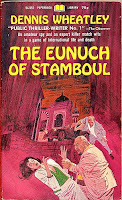
The Eunuch of Stamboul (1935)


This is what you call starting with a swagger:
.
If the postman who served the southern side of Belgrave Square that summer had not been a 'lewd fellow of the baser sort', many things might have panned out differently.
It is doubtful if Diana Duncannon would have met a certain distinguished foreigner who was then visiting London. Swithin Destime might have terminated his career, unusually brilliant to that date, as Chief of the Imperial General Staff. The life of an elderly Russian lady, then living in Constantinople as a refugee, might have been considerably prolonged, and a number of other people might not have had the misfortune to lose theirs in the flower of their youth. The Turkish Government would have found itself - but there, the postman was a 'lewd fellow of the baser sort' and, strange as it may seem, it is just upon such delicate matters as the glandular secretions of postmen and their moral reactions to the same that the destinies of human beings and the fate of nations hang.
.
So, just how do you follow The Devil Rides Out?
Do you attempt some bold new change of direction? Do you labour over a sequel that you hope will be twice as good but which will probably just be twice as long? Do you retreat into two years of indecision before daring to write again, only to have the new work tepidly received? Or do you get straight back in the saddle and come out blazing with a back to basics, business as usual barnstormer?
Wheatley, no surprise, chose the latter course, and re-entered the fray with a tale of political intrigue, exotic locales and dire peril: The Eunuch of Stamboul. It is a novel in the grand Wheatley tradition, a return to the meat and potatoes espionage thriller that he had not attempted since Forbidden Territory, and yet another unqualified success.
.
It also makes for fascinating reading just now, since its central question - whether Turkey will embrace Western modernity or retreat into Islamist medievalism - is as relevant as ever, especially in the light of current debates over the country's fitness or otherwise for EU membership.
The action is set against the background of Kemal Ataturk's modernisation drive, which enforces religious freedom through political coercion, and concerns the planned insurrection of a group of starry-eyed jihadists who yearn for the liberty of theocratic enslavement.
This is the very paradox consuming the Middle East today, and Wheatley's commentary on it, as surprisingly even-handed as it is characteristically robust, makes for a genuinely timely read. The pleasures of a Wheatley novel are usually to be found in the remoteness of their mores and concerns from modern life, and the insight they offer into the everyday concerns of generations past. The excitement here, by contrast, is to be found in how bizarrely contemporary so much of its backdrop seems.
At first he seems foursquare on the side of the Islamists, his Dumas-loving side identifying with their renegade romanticism and oppressed-status, and finding much humour in the vulgarity of Kemal's faux-Western innovations. In one scene he contrasts the authentic Turkish musical entertainment at a secret jihadi meeting with the "revolting crooning of some western barbarian" on a transistor radio in an adjacent building, and allows a Turkish woman over two pages to convince Swithin Destime, our hero, of the rightness of polygamy: "Monogamy might suit the West perhaps although even that was doubtful, and she produced statistics to hammer home her point."
.
It was a long speech and so admirably built up that Swithin had to admit the logic of the speaker's views - at least as far as the people she represented were concerned. If these Eastern women were content to share a man, as they had done for centuries, why should they not be allowed to continue to do so and, now that many of them were taking up careers there seemed a better reason than ever for two or more to divide the labours entailed by children and a home between them. Of course, few Western women, he realised, would be content to accept so short a sex life, that was the big snag, but apart from it and the question of Christian morality, the system, if adhered to, appeared wholesome when compared with the scandalous fraud and collusion which arise from the English divorce laws...
.
Destime is almost swayed by the rhetoric of heroic idealist Reouf:
.
"Kemal did much for Turkey in the War and after, but he has sacrificed the soul of our nation for the material trappings of the West. We are not a European people and we never shall be. No wearing of bowler hats, jazz music and the co-education will ever make us so. We are Asiatics and the ways of our fathers which endured for centuries are those best-suited to our needs."
"Yet, you admit that sweeping reforms were long overdue."
"Truly - and they have now been carried out - but that could have been done without laws which force us to sin fifty times a day in the sight of Allah, or treaties which tie us down to the permanent acceptance of territorial limitations making us into a Third-Class State."
.
Largely because of the potential threat to British interests, however, Wheatley gradually navigates the reader into opposition, precisely at the point when political activism gives way to religious fundamentalism:
.
For one awful moment Swithin held his breath. The word 'Jehad' flamed through his brain with all its terrible possibilities. Of the patriotic ravings of young Reouf he had taken little stock but this was a very different business. It even far exceeded the scope of the determined internal revolution of which he had learned in the last ten minutes, for a Jehad meant the preaching of a Holy War. These people were not out only to destroy Kemal and reinstate the old law of the Koran but, with all the bitter zeal of blind fanaticism, they meant to carry their full programme into actual practice. It meant the certainty of another flare-up in the Balkans, their co-religionists would probably rise in sympathy and begin massacres of Europeans in India, Syria, Palestine, Egypt, Algeria and, taking into consideration the unstable state of things in Europe, perhaps even be the kindling spark leading to the supreme horror of a war to the death between fresh combinations of the Great Powers.
.
How chilling is that line: "... their co-religionists would probably rise in sympathy and begin massacres of Europeans in India..."? As Wheatley has one character note in typical style: "there's no reasoning with these birds..."
Here, though, Britishness is still a force to be measured:
.
The Daimler's engine purred and, with a superior glance at Malik, the cockney chauffeur let in the clutch. The Turk stood watching with impotent fury blazing in his eyes. He would cheerfully have given five years of his life to be able to draw his gun and haul Swithin out of the car at the point of it - but he dared not. A small silk Union Jack fluttered gaily from a slim staff on the Daimler's bonnet. No policeman - be he black, white, yellow, or brown, lays hands with impunity upon the property of His Britannic Majesty's accredited representatives the wide world over - and Malik knew it. Stirred by profound emotion he spat, while Swithin, no less stirred by the portentous meaning of that little flag, looked away quickly and lit a cigarette.
.
.
As noted, our hero is one Swithin Destime, Wheatley's most delicious name for a hero since Black August's Kenyon Wensleydale. He's kicked out of the Guards when he comes to the aid of dishy Diana Duncannon at a dinner party, by punching a "garlic-eating bounder" pestering her on the lawn. When the bounder turns out to be Prince Ali of Turkey, a sensitive political situation can only be avoided by having Destime, and his fellow pugilist Peter Carew, resign their commissions. Later, however, Diana's father offers Destime a job at the Turkish depot of his tobacco company, so as to snoop undercover among the locals and discern if there is any truth to the rumour that some form of uprising in the offing, and if there is, what that might mean for Blighty.
Diana ("cool and lovely in an outrageously fashionable hat") is a slightly new kind of Wheatley heroine: not merely feisty and resourceful (as was customary in his books) but the controlling force, and coquettish to boot. She repeatedly makes a fool of Destime, who is still underestimating her to the very end. He, by contrast, is a pretty hopeless amateur, relying chiefly on luck, guesswork and fisticuffs: exactly like the literary heroes with whom Diana mockingly compares him.
And Wheatley being Wheatley, he can't resist making the comparisons explicit:
.
In his mind, he sought desperately for a way of escape, but he could think of nothing. Again Diana's taunt came back to him and he wondered miserably just what those gifted amateurs of fiction did when they had walked blithely into the arms of their enemies. Bulldog Drummond, he supposed, would have tackled the present situation with fantastic ease... Bulldog might not be exactly subtle, but at times he certainly possessed the advantage of being devastatingly heavy handed. Then there was that other fellow, an infinitely more dangerous gentleman adventurer, 'The Saint'. Swithin had followed his amazing prowess in many countries, through fifteen novels, and admired him greatly. The remarkable flow of cheerful badinage which he managed to sustain even in the most desperate situations was a joy to read, and his methods a perfect example of how matters should be handled in the present instance.
.
But Swithin is no Saint, and virtually every major suspense episode is motivated by him behaving foolishly:
.
He had failed - failed utterly from the very beginning. By not foreseeing that Tania's was such a likely post for the police to plant a spy he had given himself away to Kazdim through entrusting her with that letter. By failing to catch and warn Reouf of Kazdim's identity that night when they left the cafe together he felt that he had been largely responsible for the poor boy's death. By not troubling to take the most elementary precautions at his flat he had walked blindly into the arms of the enemy, then, when almost miraculously his life had been spared, he had been crazy enough to place himself in Ali's clutches, where the veriest tyro would at least have taken care to find out the name of the Military Governor of Constantinople before risking a visit to him - and now, by his supreme folly in asking Diana to meet him at the Tobacco Depot, he had given her away to Kazdim too.
He had failed, not only in carrying out his mission, which he realised now was a thing of comparatively small account, since it only concerned investing certain sums of money but, through his incompetence, new wars were to be sprung on an unsuspecting world and , above all - a thing far nearer home - that woman whom he had considered hard and selfish but who was brave and proud, and whom he now knew that he loved so that he would go down to hell itself to help her, was to be humiliated, befouled, broken and tortured, in body and spirit. His cup of bitterness brimmed and spilled over when he recalled his refusal to take her warning - that he had not the brain or nerve for the job he had taken on so arrogantly - and knew it to be true.
.
He does redeem himself, for sure, but thanks to a lot of luck.
.
As for Kazdim, the Eunuch himself, he's the head of the secret police, and a clandestine Islamist, much given to tying his enemies' limbs together and dumping them in deep water.
I suppose Wheatley must have realised that after Mocata his readers would no longer accept a mere ruffian for a villain. Kazdim, therefore, is a real showstopper:
.
He was a tall man with immensely powerful shoulders but the effect of his height was minimized by his gigantic girth. He had the stomach of an elephant and would easily have turned the scale at twenty stone. His face was even more unusual than his body for apparently no neck supported it and it rose straight out of his shoulders like a vast inverted U. The eyes were tiny beads in that vast expanse of flesh and almost buried in folds of fat, the cheeks puffed out, yet withered like the skin of a last year's apple, and the mouth was an absurd pink rosebud set above a seemingly endless cascade of chins.
.
The book offers the best example yet of Wheatley's climax-upon-climax formula: knowing, perhaps, that he wasn't going to top Devil Rides Out conceptually (though the astral bodies put in a reappearance), he has gone all out to top each action climax with another. The book just doesn't want to stop, and there are times when you wonder if it ever will. But it works: the effect is neither counterproductively exhausting, nor ridiculous.
Especially notable here is how the secondary character of Peter is used to achieve this effect, since it shows a genuinely clever awareness of narrative structure. The character is present at the beginning, cleverly reintroduced halfway through, and then held in reserve for Wheatley's cleverest 'last dash' yet, stepping in to foul up the works after Destime's efforts, finally, appear to have succeeded.
Our heroes are saved, ultimately, by the timely intervention of Tania, ("attractive enough to have caught the eye of the most hardened misogynist"), Kazdim's gorgeous paid agent. Swithin gets the measure of her halfway through, but Peter falls hard and naive for her, and as soon as he is entrusted with the important government commission to which all Destime's efforts have been directed, he promptly makes an ass of himself and allows her to betray him as ordered.
But now, tormented by conscience, and driven mad with guilt and hatred after the death of her mother at Kazdim's hands, her (literally) insane bravery saves the day at the cost of her own life.
This is also something new for Wheatley: his first tragic heroine, inspired perhaps by Devil's Tanith, whom he had shockingly killed halfway through, only to wimp out and bring back to life a few chapters later. Tania, who resembles Tanith in more than just name (the unwilling servant of the principal villain, loved by a secondary male hero who wants to 'take her away from all of this', a refugee) gets no second chance, and her death is powerfully woven by Wheatley into the breakneck action climax.
Ultimately, Swithin, Diana and Peter foil the revolution, avert catastrophe, earn the undying loyalty of Kemal (the first example in Wheatley of a real-life figure with a speaking role) and save the British Empire - temporarily at least.
The book ends with an official proclamation from Kemal to his people, to which one can only add 'Amen':
.
Those followers of the Prophet who wish to continue the practice of their ancient faith are free to do so, as also are the Christians and the Jews. But let them beware how they attempt to tamper with the machinery of State. Religion and nationality are things apart.
.
If you hate Wheatley's style, good luck to you and there's no more to be said.
But if you do have a sweet tooth for this kind of thing, this is one of his most efficient displays yet.
No sign yet of autopilot.