Showing posts with label Religion. Show all posts

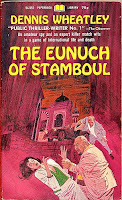
The Eunuch of Stamboul (1935)


This is what you call starting with a swagger:
.
If the postman who served the southern side of Belgrave Square that summer had not been a 'lewd fellow of the baser sort', many things might have panned out differently.
It is doubtful if Diana Duncannon would have met a certain distinguished foreigner who was then visiting London. Swithin Destime might have terminated his career, unusually brilliant to that date, as Chief of the Imperial General Staff. The life of an elderly Russian lady, then living in Constantinople as a refugee, might have been considerably prolonged, and a number of other people might not have had the misfortune to lose theirs in the flower of their youth. The Turkish Government would have found itself - but there, the postman was a 'lewd fellow of the baser sort' and, strange as it may seem, it is just upon such delicate matters as the glandular secretions of postmen and their moral reactions to the same that the destinies of human beings and the fate of nations hang.
.
So, just how do you follow The Devil Rides Out?
Do you attempt some bold new change of direction? Do you labour over a sequel that you hope will be twice as good but which will probably just be twice as long? Do you retreat into two years of indecision before daring to write again, only to have the new work tepidly received? Or do you get straight back in the saddle and come out blazing with a back to basics, business as usual barnstormer?
Wheatley, no surprise, chose the latter course, and re-entered the fray with a tale of political intrigue, exotic locales and dire peril: The Eunuch of Stamboul. It is a novel in the grand Wheatley tradition, a return to the meat and potatoes espionage thriller that he had not attempted since Forbidden Territory, and yet another unqualified success.
.
It also makes for fascinating reading just now, since its central question - whether Turkey will embrace Western modernity or retreat into Islamist medievalism - is as relevant as ever, especially in the light of current debates over the country's fitness or otherwise for EU membership.
The action is set against the background of Kemal Ataturk's modernisation drive, which enforces religious freedom through political coercion, and concerns the planned insurrection of a group of starry-eyed jihadists who yearn for the liberty of theocratic enslavement.
This is the very paradox consuming the Middle East today, and Wheatley's commentary on it, as surprisingly even-handed as it is characteristically robust, makes for a genuinely timely read. The pleasures of a Wheatley novel are usually to be found in the remoteness of their mores and concerns from modern life, and the insight they offer into the everyday concerns of generations past. The excitement here, by contrast, is to be found in how bizarrely contemporary so much of its backdrop seems.
At first he seems foursquare on the side of the Islamists, his Dumas-loving side identifying with their renegade romanticism and oppressed-status, and finding much humour in the vulgarity of Kemal's faux-Western innovations. In one scene he contrasts the authentic Turkish musical entertainment at a secret jihadi meeting with the "revolting crooning of some western barbarian" on a transistor radio in an adjacent building, and allows a Turkish woman over two pages to convince Swithin Destime, our hero, of the rightness of polygamy: "Monogamy might suit the West perhaps although even that was doubtful, and she produced statistics to hammer home her point."
.
It was a long speech and so admirably built up that Swithin had to admit the logic of the speaker's views - at least as far as the people she represented were concerned. If these Eastern women were content to share a man, as they had done for centuries, why should they not be allowed to continue to do so and, now that many of them were taking up careers there seemed a better reason than ever for two or more to divide the labours entailed by children and a home between them. Of course, few Western women, he realised, would be content to accept so short a sex life, that was the big snag, but apart from it and the question of Christian morality, the system, if adhered to, appeared wholesome when compared with the scandalous fraud and collusion which arise from the English divorce laws...
.
Destime is almost swayed by the rhetoric of heroic idealist Reouf:
.
"Kemal did much for Turkey in the War and after, but he has sacrificed the soul of our nation for the material trappings of the West. We are not a European people and we never shall be. No wearing of bowler hats, jazz music and the co-education will ever make us so. We are Asiatics and the ways of our fathers which endured for centuries are those best-suited to our needs."
"Yet, you admit that sweeping reforms were long overdue."
"Truly - and they have now been carried out - but that could have been done without laws which force us to sin fifty times a day in the sight of Allah, or treaties which tie us down to the permanent acceptance of territorial limitations making us into a Third-Class State."
.
Largely because of the potential threat to British interests, however, Wheatley gradually navigates the reader into opposition, precisely at the point when political activism gives way to religious fundamentalism:
.
For one awful moment Swithin held his breath. The word 'Jehad' flamed through his brain with all its terrible possibilities. Of the patriotic ravings of young Reouf he had taken little stock but this was a very different business. It even far exceeded the scope of the determined internal revolution of which he had learned in the last ten minutes, for a Jehad meant the preaching of a Holy War. These people were not out only to destroy Kemal and reinstate the old law of the Koran but, with all the bitter zeal of blind fanaticism, they meant to carry their full programme into actual practice. It meant the certainty of another flare-up in the Balkans, their co-religionists would probably rise in sympathy and begin massacres of Europeans in India, Syria, Palestine, Egypt, Algeria and, taking into consideration the unstable state of things in Europe, perhaps even be the kindling spark leading to the supreme horror of a war to the death between fresh combinations of the Great Powers.
.
How chilling is that line: "... their co-religionists would probably rise in sympathy and begin massacres of Europeans in India..."? As Wheatley has one character note in typical style: "there's no reasoning with these birds..."
Here, though, Britishness is still a force to be measured:
.
The Daimler's engine purred and, with a superior glance at Malik, the cockney chauffeur let in the clutch. The Turk stood watching with impotent fury blazing in his eyes. He would cheerfully have given five years of his life to be able to draw his gun and haul Swithin out of the car at the point of it - but he dared not. A small silk Union Jack fluttered gaily from a slim staff on the Daimler's bonnet. No policeman - be he black, white, yellow, or brown, lays hands with impunity upon the property of His Britannic Majesty's accredited representatives the wide world over - and Malik knew it. Stirred by profound emotion he spat, while Swithin, no less stirred by the portentous meaning of that little flag, looked away quickly and lit a cigarette.
.
.
As noted, our hero is one Swithin Destime, Wheatley's most delicious name for a hero since Black August's Kenyon Wensleydale. He's kicked out of the Guards when he comes to the aid of dishy Diana Duncannon at a dinner party, by punching a "garlic-eating bounder" pestering her on the lawn. When the bounder turns out to be Prince Ali of Turkey, a sensitive political situation can only be avoided by having Destime, and his fellow pugilist Peter Carew, resign their commissions. Later, however, Diana's father offers Destime a job at the Turkish depot of his tobacco company, so as to snoop undercover among the locals and discern if there is any truth to the rumour that some form of uprising in the offing, and if there is, what that might mean for Blighty.
Diana ("cool and lovely in an outrageously fashionable hat") is a slightly new kind of Wheatley heroine: not merely feisty and resourceful (as was customary in his books) but the controlling force, and coquettish to boot. She repeatedly makes a fool of Destime, who is still underestimating her to the very end. He, by contrast, is a pretty hopeless amateur, relying chiefly on luck, guesswork and fisticuffs: exactly like the literary heroes with whom Diana mockingly compares him.
And Wheatley being Wheatley, he can't resist making the comparisons explicit:
.
In his mind, he sought desperately for a way of escape, but he could think of nothing. Again Diana's taunt came back to him and he wondered miserably just what those gifted amateurs of fiction did when they had walked blithely into the arms of their enemies. Bulldog Drummond, he supposed, would have tackled the present situation with fantastic ease... Bulldog might not be exactly subtle, but at times he certainly possessed the advantage of being devastatingly heavy handed. Then there was that other fellow, an infinitely more dangerous gentleman adventurer, 'The Saint'. Swithin had followed his amazing prowess in many countries, through fifteen novels, and admired him greatly. The remarkable flow of cheerful badinage which he managed to sustain even in the most desperate situations was a joy to read, and his methods a perfect example of how matters should be handled in the present instance.
.
But Swithin is no Saint, and virtually every major suspense episode is motivated by him behaving foolishly:
.
He had failed - failed utterly from the very beginning. By not foreseeing that Tania's was such a likely post for the police to plant a spy he had given himself away to Kazdim through entrusting her with that letter. By failing to catch and warn Reouf of Kazdim's identity that night when they left the cafe together he felt that he had been largely responsible for the poor boy's death. By not troubling to take the most elementary precautions at his flat he had walked blindly into the arms of the enemy, then, when almost miraculously his life had been spared, he had been crazy enough to place himself in Ali's clutches, where the veriest tyro would at least have taken care to find out the name of the Military Governor of Constantinople before risking a visit to him - and now, by his supreme folly in asking Diana to meet him at the Tobacco Depot, he had given her away to Kazdim too.
He had failed, not only in carrying out his mission, which he realised now was a thing of comparatively small account, since it only concerned investing certain sums of money but, through his incompetence, new wars were to be sprung on an unsuspecting world and , above all - a thing far nearer home - that woman whom he had considered hard and selfish but who was brave and proud, and whom he now knew that he loved so that he would go down to hell itself to help her, was to be humiliated, befouled, broken and tortured, in body and spirit. His cup of bitterness brimmed and spilled over when he recalled his refusal to take her warning - that he had not the brain or nerve for the job he had taken on so arrogantly - and knew it to be true.
.
He does redeem himself, for sure, but thanks to a lot of luck.
.
As for Kazdim, the Eunuch himself, he's the head of the secret police, and a clandestine Islamist, much given to tying his enemies' limbs together and dumping them in deep water.
I suppose Wheatley must have realised that after Mocata his readers would no longer accept a mere ruffian for a villain. Kazdim, therefore, is a real showstopper:
.
He was a tall man with immensely powerful shoulders but the effect of his height was minimized by his gigantic girth. He had the stomach of an elephant and would easily have turned the scale at twenty stone. His face was even more unusual than his body for apparently no neck supported it and it rose straight out of his shoulders like a vast inverted U. The eyes were tiny beads in that vast expanse of flesh and almost buried in folds of fat, the cheeks puffed out, yet withered like the skin of a last year's apple, and the mouth was an absurd pink rosebud set above a seemingly endless cascade of chins.
.
The book offers the best example yet of Wheatley's climax-upon-climax formula: knowing, perhaps, that he wasn't going to top Devil Rides Out conceptually (though the astral bodies put in a reappearance), he has gone all out to top each action climax with another. The book just doesn't want to stop, and there are times when you wonder if it ever will. But it works: the effect is neither counterproductively exhausting, nor ridiculous.
Especially notable here is how the secondary character of Peter is used to achieve this effect, since it shows a genuinely clever awareness of narrative structure. The character is present at the beginning, cleverly reintroduced halfway through, and then held in reserve for Wheatley's cleverest 'last dash' yet, stepping in to foul up the works after Destime's efforts, finally, appear to have succeeded.
Our heroes are saved, ultimately, by the timely intervention of Tania, ("attractive enough to have caught the eye of the most hardened misogynist"), Kazdim's gorgeous paid agent. Swithin gets the measure of her halfway through, but Peter falls hard and naive for her, and as soon as he is entrusted with the important government commission to which all Destime's efforts have been directed, he promptly makes an ass of himself and allows her to betray him as ordered.
But now, tormented by conscience, and driven mad with guilt and hatred after the death of her mother at Kazdim's hands, her (literally) insane bravery saves the day at the cost of her own life.
This is also something new for Wheatley: his first tragic heroine, inspired perhaps by Devil's Tanith, whom he had shockingly killed halfway through, only to wimp out and bring back to life a few chapters later. Tania, who resembles Tanith in more than just name (the unwilling servant of the principal villain, loved by a secondary male hero who wants to 'take her away from all of this', a refugee) gets no second chance, and her death is powerfully woven by Wheatley into the breakneck action climax.
Ultimately, Swithin, Diana and Peter foil the revolution, avert catastrophe, earn the undying loyalty of Kemal (the first example in Wheatley of a real-life figure with a speaking role) and save the British Empire - temporarily at least.
The book ends with an official proclamation from Kemal to his people, to which one can only add 'Amen':
.
Those followers of the Prophet who wish to continue the practice of their ancient faith are free to do so, as also are the Christians and the Jews. But let them beware how they attempt to tamper with the machinery of State. Religion and nationality are things apart.
.
If you hate Wheatley's style, good luck to you and there's no more to be said.
But if you do have a sweet tooth for this kind of thing, this is one of his most efficient displays yet.
No sign yet of autopilot.

The Devil Rides Out (1934)


Go on, admit it.
You know you can quote it by heart...

I desire to state that I, personally, have never assisted at, or participated in, any ceremony connected with Magic - Black or White. (...)
Should any of my readers incline to a serious study of the subject, and thus come into contact with a man or woman of Power, I feel that it is only right to urge them, most strongly, to refrain from being drawn into the practice of the Secret Art in any way. My own observations have led me to an absolute conviction that to do so would bring them into dangers of a very real and concrete nature.
DENNIS WHEATLEY


This opening disclaimer is perhaps the most instantly familiar piece of writing in the entire Wheatley canon. Personally, it immediately whisks me back to the late nineteen seventies, and to the smell of jumble sale paperbacks curling in the sun...
It also reminds me just what an astute judge of his audience Wheatley was. He realised instinctively that this was the book where he could achieve a more impressive frisson by bragging about the research he hasn't done rather than the research he has done.

But did he think, as he wrote it, that this was going to be the book, the one that would see him safely into posterity? He might well have guessed that it could become his most famous effort - but could he have ever guessed that for many, many millions it would be the only title his name would evoke? That it was, perhaps, the one thing that would save him from literary oblivion?

How did he get the idea? According to his own recollections, it was no big deal. In Drink and Ink he writes:

After finishing The Fabulous Valley, I tried very hard to think of a subject for my next book that would hit another high spot. It then occurred to me that, although in Victorian times there had been a great vogue for stories of the occult, in the present century there had been very few; so I decided to use the theme of Black Magic.

If it really was that casual, I'm almost inclined to believe in supernatural inspiration after all!
When accounting for the key to the book's enormous success, we must first acknowledge its canny air of authenticity. The suspension of disbelief necessary for a reader to engage with a fantasy story is aided immeasurably by the sense of learned authority with which Wheatley pronounces upon what are, after all, the battiest imaginable subjects. The fru
its from the (now typical) mountains of research through which he ploughed found their way intact to the page: long, rambling monologues on such subjects as palmistry, alchemy, astrology and a bewildering catalogue of similar nonsense; even the existence of werewolves is given a fair hearing. Many of these subjects, biographer Phil Baker notes, Wheatley had begun studying during the war, when the carnage, and the seeming hypocrisy with which both sides accredited their victories to the same God, served to distance him still further from the Christianity he claimed to have disowned from childhood.
The plethora of sources Wheatley relied upon for all this information have been extensively enumerated by other writers, and Baker does a useful job of tracing back each purple stretch of metaphysical speculation to its origins in one or another of the dozens of obscure treatises and testimonies Wheatley consulted (or had pressed upon him by some dubious new acquaintances like Montague Summers and Alesiter Crowley).
As always when Wheatley knew he was relying generously on the work of others he simply acknowledged it: De Richleau's line "Sir George Frazer's The Golden Bough will tell you all about it" - in the middle of a very long passage about the Moon Goddess of the Carthaginians - is typical.

But the result of all this is not to weight the book down and try the reader's patience, though it seems Wheatley feared it might. (Baker reminds us that
Wheatley originally inserted a questionnaire in the back of the book, concerned that readers might not want their thrills punctuated with so much esoterica, and soliciting their views on the matter.) Though the oft-made claim that Wheatley's mix of narrative and research is always crudely done gets never a welcome here, there is no question that this is an especially seamless and creative example of the technique: the research helps make the plot believable, the plot helps make the research interesting.
And though he may not have personally summoned the Goat of Mendes and invited him round for a sherry and a Hoyo de Monterrey, Wheatley did make the acquaintance of a number of prominent British occultists for some juicy tidbits.
Chief among them, as already noted, was the repellent charlatan Aleister Crowley, whose self-propagated reputation for genuine diabolistic prowess persists in certain circles even today. (His talent for self-aggrandisement is probably the only amusing thing about him: he once claimed to have fallen out with Yeats because the latter was jealous of Crowley's greater talent for poetry.)

By the time he met Wheatley his glory days, such as they were, were far behind him and he cut an unmistakably pathetic figure, all the more so for the pompous bravado with which he sought to disguise the fact. Wheatley, who saw through just about every species of humbug except supernatural humbug, had him pegged correctly from the start ("I don't believe he could harm a rabbit"), but a mutual acquaintance convinced him that Crowley had lost his powers as the result of a legendary, partially successful attempt to raise Pan in Paris that left one man dead and Crowley temporarily insane. (
This story, central to the Crowley mystique, seems to acquire a new fantastic embellishment with each retelling: it is an interesting exercise to trace its journey backwards to the typically sordid and unmysterious truth.)


Dear Dennis, Love Aleister - one showman writes to another

Apparently the book owes much to a novel of Crowley's called Moonchild, but one obvious fictional source that is rarely cited as the formative influence it so clearly is, oddly enough, is Stoker's Dracula.
We know that the novel was very much a standard for this kind of endeavour, indeed several of the paperback editions carried a quote from James Hilton in the Daily Telegraph: "The best thing of its kind since Dracula." But it is strange that the superficial differences between the two works made and continue to make such a good job of disg

uising the many essential similarities.
Consider first the similarities in the plot: A supernatural evil that survives by spreading and corrupting the innocent has taken control of two of our heroes. To combat it, a group of friends aided by the specialist knowledge of an older savant confront it and then track it to its mountain lair before vanquishing it. Hypnotism of one of its partial victims aids them in their quest. With the prime evil destroyed, its influence vanishes from those it has affected.
Now observe the detail.
There is this highly reminiscent passage, in which Wheatley points out the power and danger of his Satanists:

"They can control all the meaner things - bats, snakes, rats, foxes, owls - as well as cats and certain breeds of dog like the Wolfhound and Alsatian. (...)
Remember too this is still Walpurgis-Nacht and every force of evil that is abroad will be leagued against us."


Here we detect echoes both of the villager sharing Jonathan Harker's coach at the beginning of Dracula ("It is the Eve of St George's Day. Do you not know that tonight, when the clock strikes midnight, all the evil things in the world will have full sway?"), and Van Helsing's later summary of the vampire's powers ("he can command all the meaner things: the rat, and the owl, and the bat--the moth, and the fox, and the wolf").
The links between black magic and vampirism are stressed in this fascinating dialogue between Rex and Tanith (who hails, like Dracula, from the Carpathians):


Rex passed his hand wearily across his eyes. "Don't speak in riddles, treasure. What is this thing you're frightened of? Just tell me now in ordinary, plain English."
"All right. I suppose you have heard of a vampire."
"Why, yes. I've read of them in fiction. They're supposed to come out of their graves every night and drink the blood of human beings, aren't they? Until they're found out, then their graves are opened up for a priest to cut off their head and drive stakes through their hearts."


Exactly this De Richleau proposes doing when Tanith dies, in a scene entirely reminiscent of Van Helsing's preparations to free the soul of the vampirised Lucy, over the objections of his grieving companions:

"She is dead as we know death, " said Richard slowly. "So what could remain?"
"I know what he means," the Duke remarked abruptly. "He is afraid that an elemental may have taken possession of her corpse. If so drastic measures will be necessary."
"No!" Rex shook his head violently. "If you're thinking of cutting off her head and driving a stake through her heart, I won't have it. She's mine, I tell you - mine!"
"Better that than the poor soul should suffer the agony of seeing its body come out of the grave at night to fatten itself on human blood," De Richleau murmured. "But there are certain tests, and we can soon find out. Bring her over here."
Simon and Richard lifted the body and carried it over to the mat of sheets and blankets in the centre of the pentacle, while De Richleau fiddled for a moment among his impedimenta.
"The Undead," he said slowly, "have certain inhibitions. They can pass as human, but they cannot eat human food and they cannot cross running water except at sunset and sunrise. Garlic is a most fearsome thing to them, so that they scream if only touched by it, and the Cross, of course, is anathema. We will see if she reacts to them. "
As he spoke he took the wreath of garlic flowers from round his neck and placed it about Tanith's. Then he made the sign of the Cross above her and laid his little gold crucifix upon her lips.


There seems little room for doubt that Dracula was fresh in Wheatley's mind the day he wrote that. I would think he had almost certainly read it, quite sensibly, in preparation as he embarked on the writing of a novel in a very different genre to anything he had attempted before, and that perhaps, as one of the very few fiction sources on his reading list, it influenced the structure and plot of the finished work more substantially than even he realised.

Such is the book's importance as Wheatley's first black magic novel, it is easy to overlook the fact that it is also the first of Wheatley's novels in which characters from an earlier novel reappear.
'Those modern musketeers', the Duke de Richleau ("art connoisseur and dilettante"), Simon Aron ("the frail, narrow-shouldered English Jew"), Rex Van Ryn ("giant shouldered, virile and powerful" with "his ugly, attractive, humorous young face") and Richard Eaton ("sceptical... but devoted to his friends whatever their apparent folly"), who had first appeared in the as yet unpublished Three Inquisitive People and made their official debut in Wheatley's first novel The Forbidden Territory, are here pressed back into service to grapple with the forces of darkness.
The regular reader is thus given the double pleasure of seeing familiar old friends return, and not in a mere retread of their earlier adventure but rather in a totally different and thrilling new context.

It is interesting to speculate why Wheatley chose to revive them in this story at this time. It is not merely the fact that Wheatley loved these Dumas-inspired adventurers and simply couldn't wait to use them again. I think it might well have struck him how easily they could be made to fit into the structure of Dracula: Simon as Jonathan, Rex as Quincy Morris, Richard as Arthur Holmwood, Tanith as Lucy, Marie Lou as Mina and above all De Richleau as Van Helsing: the older, slightly mysterious, slightly eccentric but immensely wise leader of the group, a man of incredible knowledge, ingenuity and authority, and an expert on seemingly every subject under the sun.

De Richleau's past is as intriguing as his present - we know that as a consequence of his part in a failed coup to reestablish the French monarchy in the 1890s, a "government of bourgeois and socialists" have barred him from ever returning to his native France - and he is therefore a man very much after Wheatley's heart. His taste in all things is impeccable, even if Wheatley dares on rare occasions to question it, as in the decor of his bathroom:


Some people might have considered it a little too striking to be in perfect taste, but De Richleau did not subscribe to the canon which has branded ostentation as vulgarity in the last few generations, and robbed nobility of any glamour which it may have possessed in more spacious days.

So take that! And isn't 'more spacious days' a lovely little phrase? Of course, things are not what they once were, but he's pragmatic enough to make the best of it:

His forebears had ridden with thirty-two footmen before them, and it caused him considerable regret that modern conditions made it impossible for him to drive in his Hispano with no more than one seated beside his chauffeur on the box. Fortunately his resources were considerable and his brain sufficiently astute to make good, in most years, the inroads which the tax gatherers made upon them. 'After him,' of course 'the Deluge' as he very fully recognised, but with reasonable good fortune he considered that private ownership would last out his time, at least in England where he had made his home; and so he continued to do all things on a scale suitable to a De Richleau, with the additional lavishness of one who had had a Russian mother, as far as the restrictions of twentieth-century democracy would allow.

This much we knew already. Now we learn that he also knows tons of stuff about black magic, which is handy, as yet again one of the four is in dire peril; not Rex this time but naive Simon, who has got himself mixed up with a bunch of high society devil worshippers, led by the bald and lisping Damien Mocata, addicted to chocolate and reminding one character of an enormous egg.
His followers are a motley assortment of creeps and crazies, and virtually every reviewer of the recent biography has relished quoting Wheatley's summing-up of them: the mandarin "whose slit eyes betrayed a cold, merciless nature", the hare-lipped "red-faced Teuton", the "fat, oily-looking Babu in a salmon pink turban" and, of course, the French banker with half of one ear missing. A grisly catch indeed, but hardly evidence of any sin greater than reliance upon literary cliché.
It's certainly not the case that Wheatley pits all this foreign nastiness against all-English heroes. Three of the book's five heroes are equally un-English - a Frenchman, an American and a Russian - to which Wheatley adds a Jewish fourth with admirable obliviousness to how unusual and admirable the gesture is. 
As for the physical anomalies; well, Wheatley just loves describing such things, and he doesn't stop at the villains. De Richleau has "devil's eyebrows", Gregory Sallust a disfiguring scar that gives him a "queerly satanic" appearance, Rex is "ugly", Simon frail and narrow-shouldered with a beak-like nose. (Later, in Mayhem In Greece, Wheatley became surely the first and only writer of mass-market thrillers to feature a mentally-retarded hero.)


Another odd myth that has grown around the book, articulated at length by Baker, is that it is an 'appeasement novel', subtly promoting the cause of rapprochement with Nazi Germany.
"In all his interviews about his career and the genesis of The Devil Rides Out," writes Baker, "Wheatley never once mentions the salient fact that it is an Appeasement novel."
Which would indeed be odd were it true: whatever else Wheatley may have been, he was not a hypocrite and he was never afraid to nail his colours to the mast. As late as the autobiographies he was writing at the time of his death, he was still frankly and cheerfully expressing his admiration for Mussolini and Franco, but it is obvious from his writings that he always considered Nazism to be exactly what it was: Communism's evil twin, and an equal threat to personal freedom - the essence of everything he loathed. The tragedy of Mussolini, he once wrote, was his decision to throw in his lot with Hitler.
Hitler is not cited in Black August as a formative hero of the past, though Benito is. In stark contrast to scores of leftist writers and intellectuals, Hitler never had Wheatley's vote.
"Given the link between occultism and right-wing thinking, it is oddly appropriate that the greatest occult novel of the twentieth century should have a subtext of peace with Nazi Germany," continues Baker.
This is not such a 'given'. Fascism is not 'right wing', always assuming that by that nebulous term we mean some kind of Conservatism; it is a progressivist, revolutionary ideology antithetical to Conservatism's abhorrence of centralist control and the omnipotent state. This error leads to the mistaken view that Wheatley, a reactionary monarchist and unresolved stew of traditionalist and libertarian impulses, belongs politically somewhere along a road that leads to Nazism, and was thus capable of harbouring sympathies towards them. He was not.
But then, if we do allow the link between the adolescent power-worship that characterises occultism and similar political ideas compatible with Nazism (and I'm happy to for the sake of the argument) how does it make it "oddly appropriate" that a book about the opposing, tracking down and vanquishing of occultists, who are described in the most condemnatory terms throughout as vile and wicked degenerates, "should have a subtext of peace with Nazi Germany"? Surely accepting the terms of Baker's proposition would render such a thing entirely inappropriate!
And let's face it, subtext-hunting in Wheatley is a fool's errand: Wheatley rarely did anything subtly, and if he wants to make a political point, he'll make sure we don't have to go looking for it.
So what is the evidence for this unique gesture of subtextual sleight of hand on Wheatley's part?
Well, Mocata is seeking the whereabouts of the Talisman of Set (in fact the old boy's mummified penis), a kind of unholy grail, with the power to open a gateway to the underworld and allow the Four Horsemen of the Apocalypse to "poison the thoughts of peace-loving people and manipulate unscrupulous statesmen, influencing them to plunge Europe into a fresh calamity." 'Fresh' because this, De Richleau tells us, is precisely what happened prior to the Great War, and so our heroes are concerned not only with saving themselves but also preventing a second World War.
The first of two relevant passages occurs after Rex and De Richleau abduct Simon from the occultists' gathering. He is taken unconscious to the Duke's swanky flat, where Rex is amazed to see him place "a small golden swastika" around Simon's neck for protection against the infernal elements:


."... he'll be pretty livid I'll promise you. Fancy hanging a Nazi swastika around the neck of a professing Jew."
"My dear Rex! Do please try and broaden your outlook a little. The swastika is the oldest symbol of wisdom and right thinking in the world. It has been used by every race and every country at one time or other. You might just as well regard the cross as purely Christian, when we all know it was venerated in early Egypt, thousands of years before the birth of Christ. The Nazis have only adopted the swastika because it is supposed to be of Aryan origin and part of their programme aims at welding together a large section of the Aryan race. The vast majority of them have no conception of its esoteric significance and even if they bring descredit upon it, as the Spanish Inquisition did upon the cross, that could have no effect upon its true meaning."


In the context of the passage, Wheatley had no need whatever to say that the Nazis "bring discredit" upon the swastika. But he nonetheless chose to do so. A little later, allowing De Richleau a rare, perhaps even unique admission of intellectual error, he disowns it entirely:
.
Rex did as he was bid. "But why are we wearing crucifixes when you put a swastika on Simon before?" he asked.
"I was wrong. That is the symbol of Light in the East, where I learned what little I know of the Esoteric Doctrine. There, it would have proved an adequate barrier, but here, where Christian thoughts have centred on the Cross for many centuries, the crucifix has far more potent vibrations."
.


This hardly qualifies even as ambivalence towards Nazism: it is careful disassociation, tinged with frank distaste.
So with the swastika a decided red herring, all hope of establishing the book as an appeasement tract is riding on this intriguing passage, much later:
.
"You're referring to the Great War I take it," Rex said soberly.
"Of course, and every adept knows that it started because one of the most terrible Satanists who ever lived found one of the secret gateways through which to release the four horsemen."
"I thought the Germans got a bit above themselves," Rex hazarded, "although it seems that lots of other folks were pretty well as much to blame."
"You fool!" De Richleau suddenly swung upon him. "Germany did not make the War. It came out of Russia. It was Russia who instigated the murder at Sarajevo, Russia who backed Serbia to resist Austria's demands, Russia who mobilised first and Russia who invaded Germany. The monk Rasputin was the Evil genius behind it all. He was the greatest Black Magician that the world has known for centuries. It was he who found one of the gateways through which to let forth the four horsemen that they might wallow in blood and destruction - and I know the Talisman of Set to be another. Europe is ripe now for any trouble and if they are loosened again, it will be final Armageddon. This is no longer a personal matter of protecting Simon. We've got to kill Mocata before he can secure the Talisman and prevent his plunging the world into another war."
.


Now, I've read this passage over and over, forward and back, and I just can't see how it can be made to say appeasement.
The attempt to exonerate Germany from instigating the Great War was hardly a freakish stance to take at the time, and in its argument is scarcely unreasonable, though of course debatable. Neither can it be read as reflecting a veiled sympathy for modern Germany: De Richleau, as we have seen, affects a coolly dismisive view of the Nazis, exactly the view we should expect him to take of murdering, progressivist revolutionaries. Further, Wheatley the storyteller needs to justify a supernatural explanation of the affair, making Rasputin the obvious first choice of prime mover. Had Rasputin been a German, he would still have been irresistibly tailor-made for the role, and the Duke may well have amended his history lesson accordingly.

But more important than any of this is the temperament of the work, which seems to me brazenly confrontational. De Richleau is saying that vigorous action must be taken to prevent another war; he is saying that those who wish to bring fresh destruction upon Europe must be confronted and opposed. In other words, if we want to read it metaphorically, Mocata and his horsemen stand for (or behind) the warmongers, and appeasement is the very course of action that De Richleau is counselling against. The book is warning of war, and obviously wishes to avert it in time as who would not, but the appeasement of open aggressors is nowhere advocated, nor remotely consistent with Wheatley's, or de Richleau's, worldview.


In true Wheatley style, the book proceeds at a consistent pace until about the halfway mark, before resolving itself into a series of climaxes, each good enough to end the book, but each more tense and effective than the last. (And so mesmerising are the ingredients and the flavour here it is easy to forget how familiar we are with the recipe by now.)
First we have the race to the Sabbat, in an attempt to prevent Simon and Tanith from undergoing their satanic baptism. Wheatley brilliantly gives this chapter the flavour of reportage by presenting it as a series of short paragraphs, each stating the exact time at which the detailed event takes place (and also reusing the 'overlapping narrative' technique first used in
The Fabulous Valley.) It is a brave idea, and entirely successful.
Then we have the al fresco sabbat itself, at which a hideous apparition of the Goat of Mendes is summoned, and from which Rex and the Duke narrowly manage to rescue Simon by driving at the throng full-speed with their headlights on:
.


Drunk with an inverted spiritual exaltation and excess of alcohol - wild-eyed and apparently hardly conscious of each other - the hair of the women streaming disordered as they pranced, and the panting breath of the men coming in laboured gasps - they rolled and lurched, spun and gyrated, toppled, fell, picked themselves up again, and leaped with renewed frenzy in one revolting carnival of mad disorder. Then, with a final wailing screech from the violin, the band ceased and the whole party flung themselves panting and exhausted upon the ground, while the huge Goat rattled and clacked its monstrous cloven hoofs together and gave a weird laughing neigh in a mockery of applause..


This too is top-hole stuff, yet still it is merely an hors d'oeuvre, for still to come is the ordeal in the library, as the heroes crowd inside a chalk pentacle on the floor while, all around, Mocata masses the forces of evil in sustained assault:

"What's that!" exclaimed Simon, and they swung round to face the new danger. The shadows were massing into deeper blackness in one corner of the room. Something was moving there.
A dim phosphorescent blob began to glow in the darkness; shimmering and spreading into a great hummock, its outline gradually became clearer. It was not a man form nor yet an animal, but heaved there on the floor like some monstrous living sack. It had no eyes or face but from it there radiated a terrible malefic intelligence.
Suddenly there ceased to be anything ghostlike about it. The Thing had a whitish pimply shin, leprous and unclean, like some huge silver slug. Waves of satanic power rippled through its spineless body, causing it to throb and work continually like a great mass of new-made dough. A horrible stentch of decay and corruption filled the room; for as it writhed it exuded a slimy poisonous moisture which trickled in little rivulets across the polished floor. It was solid, terribly real, a living thing. They could even see long, single, golden hairs, separated from each other by ulcerous patches of skin, quivering and waving as they rose on end from its flabby body - and suddenly it began to laugh at them, a low, horrid, chuckling laugh.
.

This memorably disgusting creation, oddly reminiscent of an earlier description of Mocata himself ("He reminded me of a large white slug") proved too bizarre for the special effects team at Hammer, whotherefore replaced it in their film version with a more prosaic giant tarantula. The other thing that Wheatley is able to do and film-makers are not, of course, is control the pace, so that simply by varying the amount of detail with which he describes moments of time he is able to stretch some suspense sequences to excruciating length, and compress others to convey breathless excitement. By repeatedly doing this 'pull back, rush forward' switch here he combines nail-biting tension with brilliantly-conveyed thrills. The whole chapter is a masterly display..
But even this he tops, again using one of his tried and tested techniques. The danger reaches fever pitch, is repelled, and normaility is resumed. It feels like the end of the novel; we, and the characters, breathe deep sighs of relief.
Then he wallops us with the sudden realisation that the problem has not been solved, the peril has not gone away but only increased - in this case via the abduction of Richard's infant daughter Fleur - and what we thought was a finale is revealed as merely a prelude.
The final section is all action, an affair of chases and pursuits and escapes, with Wheatley carefully balancing the supernatural with more proasic thrills. The ordeal in the library was all spook show, and ended with the heroes gaining a tremendous amount of knowledge as to where the villain has gone, where he will be at a certain time in the future and what he intends to do with the abducted child, all obtained by supernatural means. If the book had simply allowed them to act on this and save the day - and a lesser author, figuring we've had thrills enough by this time, might well have done just that - the reader would feel cheated: suspension of disbelief in otherworldly powers is easy enough when they're working against our heroes, and provide an almost insurmountable challenge to their ingenuity, but it would be far too lazy, and dramatically unsatisfying, to use them as a cheap means of gaining them an advantage. (This is a mistake the film version makes, albeit accidentally, in its ruthless streamlining of the story after the library sequence). To omit the plane journey, the brushes with the police, the tense stand-off with the French banker and the final chase up a mountain in Greece would make the ending far too easy and uneventful after the pentacle scene, and would feel like a cheat.
This way, the reader is let back in as a participant: like the other characters, we can only stand by and watch as De Richleau intones the Su-whatsit ritual, so it does us good to get back to the tricky piloting of four-seater planes and the kind of dangers that can be solved by a good sock on the jaw. Too much esoterica can be distancing, but a little fisticuffs between the diabolic courses works wonders for keeping our appetite for spells and incantations keen, so we never feel jaded or want to accuse Wheatley of over-egging the pudding.
It also, of course, lets Wheatley the yarn-spinner loose, permits him a bit of globe-trotting, and at last gives him an excuse to get inside a fancy restaurant. (The most the plot would allow prior to the trip to Paris was a surprisingly first class country inn, though in a concession to the dramatic mood of the moment he grudgingly has the characters not really enjoy the fine spread he nonetheless lays on for them and describes for us.) And by the time we get to the ending - which is, to put it charitably, pure claptrap - we have no objections: Wheatley has us in his spell.
.
No question, this is one of the great novels of Wheatley's career, a masterly juggling act that keeps the twin balls of esoterica and action in the air over three hundred frantic pages without ever dropping them once.
It's a book that even Rex Van Ryn might have enjoyed reading, and that's praise indeed, for, when Tanith asks him if he has encountered any of the esoteric doctrines in his past reading, he explains:
.


"No, I wouldn't exactly say I have as far as I can remember. The Duke would know all about them for a certainty - and Richard Eaton too, I expect - because they're both great readers. But I'm just an ordinary chap who's content to take his reading from the popular novelists who can turn out a good, interesting story.".

Who could he have had in mind?

Old Rowley (1933)


Reflect for a moment on how confident Dennis Wheatley must have been feeling by the end of 1933!

In order to stave off bankruptcy he decides to write a novel, does so, and instantly attracts a publisher. He then writes another, has it published and sees it become an overnight bestseller, reprinted over and over again. Shortly after, the film rights are sold.
As an experiment, he writes still another novel in a mere fortnight: though somewhat guilty over the cynicism towards his readers inherent in such an exercise - a cynicism that would never be repeated - the book is another justified smash hit.
And it's still 1933...

Something of that inevitable assuredness is reflected in the fact that he chose for his next project an historical biography, though with characteristic self-deprecation he goes out of his way in the finished book to characterise it as a mere trifle, and certainly not a learned treatise.
Old Rowley would not be the only time that Wheatley turned his talents to non-fiction, but in its lightness, and the readily-conveyed pleasure the author is clearly having in the telling of it, it remains, perhaps, his most readable. Coming as it does at the end of that first extraordinary year of industry and success, it stands as one of his most justifiably confident works of all. It is still an effortless pleasure to read.
It is not, however, an uncharacteristic work, not by any means. Wheatley's voice comes through more than clearly, and the subject is obviously not arbitrarily chosen.
Wheatley is not merely interested in the reign of Charles II; he has a deep admiration for the man that gives the book a personal and polemical momentum. Charles is clearly one of Wheatley's dearest heroes, Cromwell one of his bitterest enemies - and if you happen to share those prejudices (as I do) the book is an exhilarating job of advocacy.
Wheatley argues persuasively for the identification of Charles as the key figure responsible for dragging England out of Cromwell's dark night of anti-progressive religious mania, and on to the glories of the age of Johnson:

For two hundred years his character has been belittled as a definite policy against the weak and inept Pretenders who succeeded in the Stuart line. The legend that he was nothing but an idle, dissipated Monarch dies hard. yet in the constant sifting of the sieve of time the dross of libel falls away, leaving the gold of truth revealed. The day will come when Charles will take his rightful place in history as the wise, sweet-natured King who led his people out of darkness, anarchy and persecution into the Great prosperity of the Georgian Century.

Old Rowley, sent to free his people from "the tyranny of democracy"

Actually, Wheatley has two principle aims in mind for his subject: one is rehabilitation as a statesman, the other is humanisation, as illustrated by the very title ("the sobriquet being culled from the famous stallion of that name," Wheatley informs us, "owing to the obvious similarity of their masculine vigour"), and by the tendency to depict the King's bedchamber rather than his person on the covers of the various paperback editions.
Throughout the book, Wheatley dwells on the King's amorous encounters, partly because he evidently finds them amusing in themselves, but also as a valuable corrective to what he calls "the arctic-douche of school-taught history":

Assessing Charles' women as a whole, it is doubtful if any prince in a modern, as opposed to ancient, times ever gathered together a finer seraglio. In numbers, compared to other sovereigns, they were not excessive; but Charles was a connoisseur, and each of the six great mistresses possessed some outstanding quality of wit, intellect and or passionate loveliness which made her a real personality.

In the first and more important of these two crusades, however, he is on his deadliest form, acidly rebalancing the popular record on any number of scores, not just in matters pertaining to the second Charles but to the first also:

Such men as John Hampden unquestionably did much to establish the liberties of the English people by their staunch resistance of abuses, but it should be remembered that those abuses were no personal tyrannies introduced by Charles - they were forms of government inherited from a line of sovereigns, including Henry VIII and Elizabeth, whom we have been taught to regard as great.
Yet if the more honest of the Commons had the good of the people at heart, so also had the King. Time after time we find him legislating to protect the common people from the profiteers... It was indeed very largely his anxiety to ensure a decent standard of living to the masses which gained him the bitter enmity of the capitalist classes and lost him his throne.
His kindly thought for his poorer subjects is well expressed in the proclamation by which he repealed the Lord's Day Observance Act. 'If these times be taken from them, the meaner sort who labour all the weeke should have no recreation at all to refresh their spirits, and therefore we do order that after attending prayers, every man shall be allowed to amuse himself in any decent way which he may choose.' His people got their Sunday games, but the measure earned him the undying hatred of the Puritans.
The war therefore was waged by middle-class capitalists, who wished for greater opportunities to put money in their pockets and to force their stricter form of worship on the country...

Nobody upsets apple-carts with so infectious an energy as Wheatley!
Characterising the Cromwellians as "fanatics", he notes that "before they could bring the King to trial, even his old enemy the Parliament, from which all men of moderate views had long since withdrawn, had to be purged by Colonel Pride of no less than two-thirds of its remaining members. So that it was now a mockery of its former self and only consisted of some half-hundred embittered Puritans."
On the king's execution he is mesmerising - the book is always at its strongest when Wheatley forgets it's not a novel:

Where our War Office stands now, then stood the old palace of Whitehall, and from a first floor window of it, upon the winter morning of January 30th, 1649, the King stepped out into the drifting snowflakes that swirled about the black-draped scaffold. As he went so bravely to his tragic end, every blind was drawn; and strange as it may seem, although he had been condemned as tyrant - traitor - murderer, the streets were thronged - not with a howling mob thirsting for his blood - but with a silent and a weeping people.

Likewise on the future Charles II's successful escape:

Thus after forty-three days and nights, many of which had been passed in cold and hunger and the whole in an imminent risk of capture, the King was safely conveyed out of the power of his enemies... If one includes the servants in the many houses where he rested, there must have been close on a hundred persons in the secret of his identity, and to the poorer of these the reward offered for his capture would have meant ease and plenty all their lives long. Yet there is not a single instance of any one of them endeavouring to betray their King.
The epic closes with a fair wind, and the rising sun gilding the sails of the tall ship as it stands out to sea - and we may be certain that when the news of Charles' safe arrival at Fecamp was spread abroad, many a dust-encrusted bottle was opened and many a cup of good ale drawn, that stout hearts in England might drink - 'A Health unto His Majesty'.

When Charles returns and the monarchy is restored, Wheatley tells us that "the floodgates of joy were opened", all in the country certain that "the King alone was capable of restoring the good old times, when men were free and money plentiful."
Of what had taken place in the intervening years, Wheatley paints a bleak picture indeed, with Cromwell "march(ing) through the land, hanging, burning and slaughtering with an incredible ferocity." The end of this he later characterises with a telling phrase: "(the people) had suffered the tyranny of democracy too long".
His attitude towards the Whigs, then, may safely be predicted, though his appraisal, when it comes, still surprises (deliciously) in its vehemence:

Shaftesbury's efforts resulted in the formation of the Whig Party, pledged to overthrow the Tories under Danby and to exterminate the Catholics by an English Protestant Inquisition. The type of man who made up the better elements of his following may be judged by the seventeen Gloucestershire Lords who sent a remonstrance to the King. 'Among them there was not one who either to himself or to his father could lay claim to any honourable service performed either to the King or his father during the time of the great rebellion.' As to the worst elements, they were the fanatics and madmen who pester every Government - the human dock rats from Wapping, the hooligans, the jail-birds, and the very scum of the London gutters.


In one especially interesting passage he likens the immediate post-coronation period with the aftermath of World War I, bringing unmistakable echoes of his own 'roaring twenties' period in the wine trade:

Above all, the war was over, and these people who from their early youth had known danger, hardship, uncertainty and distress, had at last come home, freed from the clutches of foreign landladies, welcomed and restored, safe once more to ride the broad acres without fear of death, imprisonment or fine - and all in the glory of an English summer.
In our own day we have known the reaction that followed upon those years of horror, when every able-bodied man received the Armistice as a reprieve from certain death or mutilation. We know that as a result of the strain which the nation had undergone, there was an epidemic of free love, and a sudden uprush of talent among the younger generation. In the pyjama and bottle parties, the night clubs, and the doings of the 'bright young people' of the early 1920s we see reflected the license of the Restoration, and in the writings of Huxley, Coward, Joyce, Sassoon, Lawrence, to name but a few, a repetition of the flame that lit the 1660s.

He goes on to regale us with a number of anecdotes concerning the antics and high-spirited pranks of the new aristocracy, reminiscent of Bertie Wooster and the Drones Club stealing policemen's helmets. One is clapped in the stocks for disguising himself as a tinker, visiting a country village and destroying, rather than mending, the people's pots and pans. Others are nearly lynched by the people for getting drunk in a tavern, stripping naked, and then assembling on the balcony "adopting all the most vicious postures in the nude which they can think of."
As well as providing a fascinating parallel between two periods of history, the passage prompts another reflection.
Recalling Wheatley's centrality to the twenties scene, and reading his list of the period's typical authors, it is intriguing to ponder how his work - to say nothing of his critical reputation - might have differed if he had felt compelled to take up his pen a half-dozen or so years earlier than he did.